Post 145: 23 April 2017, Cleveland Circles Walk 30.
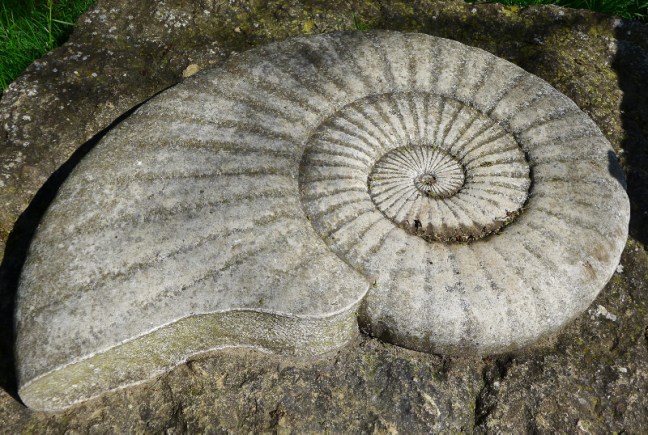
We arrived at Filey at just after 8.30am and started walking at 9.00am on a bright sunny day. Descending the ravine below Glen Gardens we passed an ammonite, albeit it a concrete one!
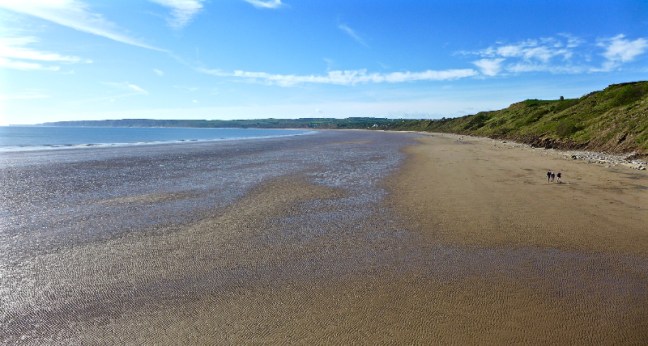
The view looking north towards Filey Brigg was a delight.
So was looking south towards Bridlington.
In the early years of the 20th Century pioneer fliers took great risks here to discover some of the secrets of flight. Not all attempts were successful.
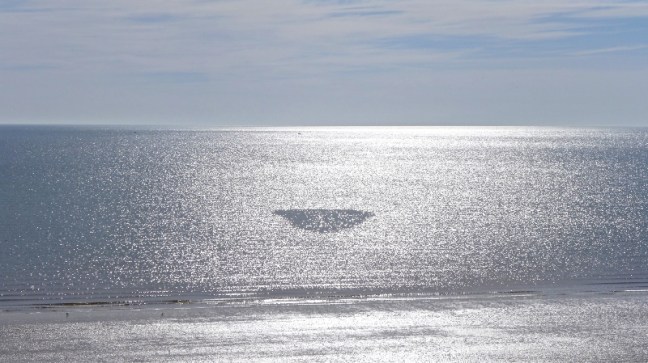
There were also a strange view out to sea – a shoal of fish, fish nets, a sand bank, sea currents, the shadow of a spacecraft? If anyone knows do let me know.
As we headed inland we were clearly ‘Away with the Fairies’
There were even public sandbag stores.
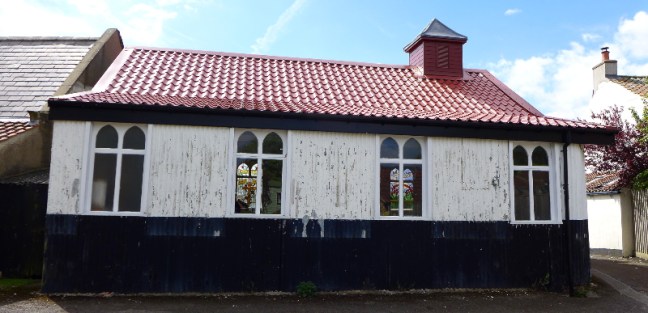
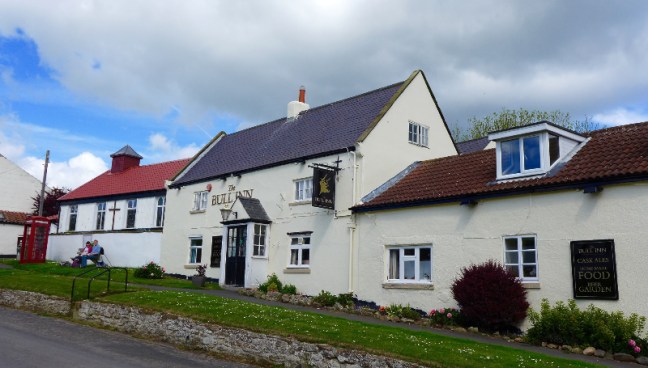
We arrived at the village of Muston for our coffee and banana break and sat outside an unusual corrugated church, with beautiful stained glass windows, and next to the nearby pub.
Muston is an attractive and well kept Yorkshire village.
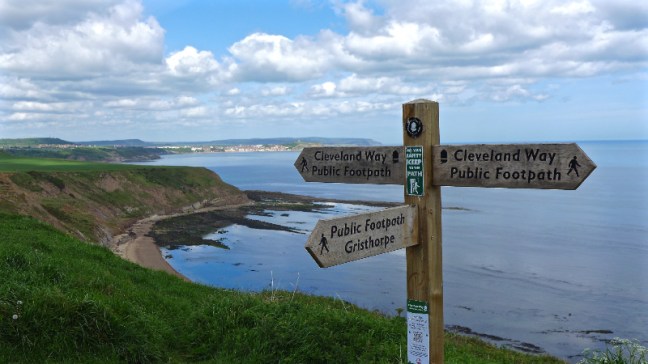
After passing through Gristhorpe we eventually reached the sea again and the Cleveland Way. When we last passed this location on the previous walk, near the Blue dolphin Holiday Park, there was only the base for a bench. This time a bench had been put in place and with stunning views we decided on an early lunch at 11.15am!
2.7 miles of delightful walking along the Cleveland Way followed
Until we reached the end of the Cleveland Way and the Cleveland Circles at Filey Brigg.
30 walks and 319 miles completed in 8 months.
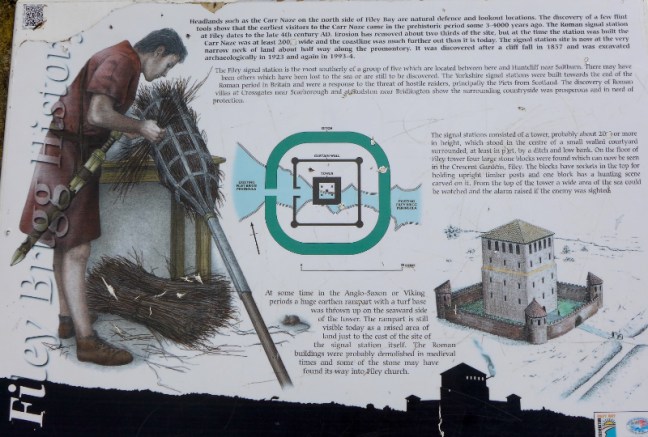
Hereabouts Romans built a signal station.
It was time now to head for Filey for a celebratory ice-cream. On such a splendid day it seemed more like the mediterranean than the East Coast of Yorkshire.
At the North Cliff Country Park an appropriately named Rambler coach was parked up.
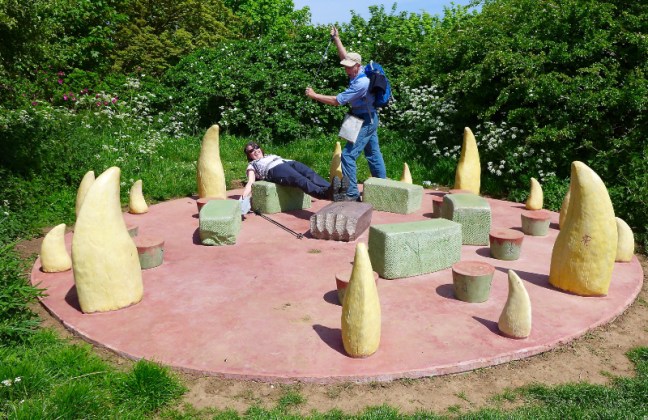
We found a sacrificial site and volunteered Carol as the victim for saying ‘how far now?’ too often.
After a visit to St Oswald’s Church,
we had two ice creams on Filey front and bade farewell to the local wildlife to return to Sid the Yorkshireman’s new ‘Techno-Orange’ coloured car and the journey home.
Post 144: 20 May 2017, The Coastliner Way, Walk 14 and 15, Goathland to Whitby.
The Coastliner Way is a new long-distance walk developed by John Eckersley, outlining a series of walks from Leeds to Whitby, Scarborough or Filey/Bridlington. Each leg of the walk starts or finishes at a Coastliner bus stop and averages about 7 miles long. Total distances add up to about 170 miles. Further details of the walk and other walking books by John can be found at his website:
We decided to walk the last two sections 14 and 15 from Goathland to Whitby on this, the launch day of the walk. Now of course this was nothing to do with the prospect of fish and chips at Whitby! We felt these sections have some of the best Yorkshire scenery on offer. We were not to be disappointed.
We started walking from the National Park car park in Goathland at 9.00am. We soon crossed the North Yorkshire Moors Railway line at the station and began ascending onto the moors.
There were fine views back towards Goathland and there were curlews and lapwings hereabouts.
A boundary stone dated 1784 was passed just after Whinstone Ridge. It was engraved Sneaton Liberty. The pylons in the background are, we believe, to be demolished at some point to improve the view across the moorland.
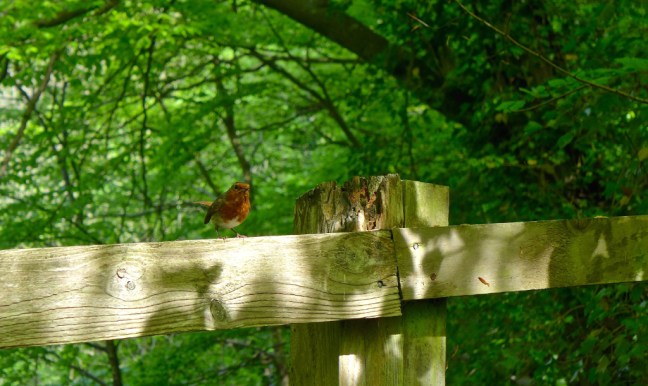
We descended to Midge Hall where we stopped for our coffee and banana break. We were joined by a robin, which we soon had eating off the top of Sid the Yorkshireman’s hat (see video on Facebook).
We were now on Alfred Wainwright’s Coast to Coast Walk, but walking in the opposite direction to most coast to coaster’s who were on their last day from St Bees to Robin Hood’s Bay. We passed a number of such walkers, including some with American/Canadian accents. They all indicated they had enjoyed their challenging walk.
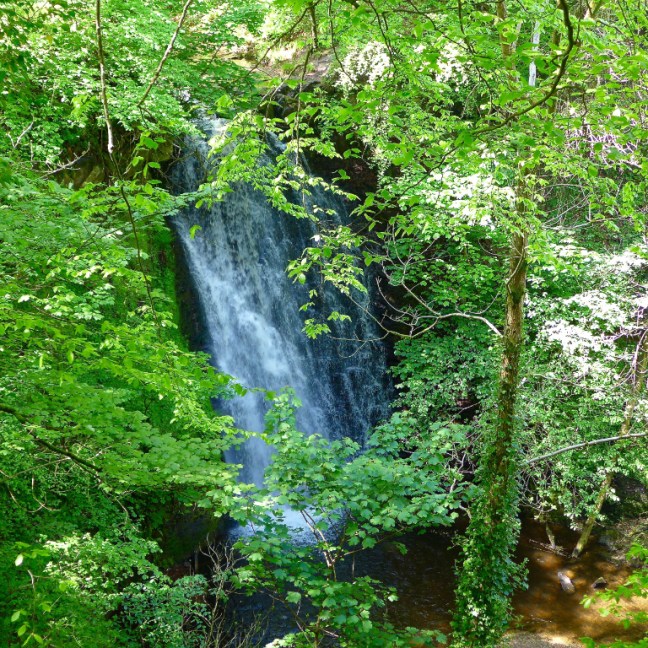
Falling Foss next to Midge Hall was a delight. Wainwright describes the area up to and including the hamlet Littlebeck as:
‘…a miniature Arcadia embowered in trees, a glimpse of heaven for nerve-frayed town-dwellers.’
Before Littlebeck we arrived at a huge boulder called ‘The Hermitage’. It has seats and is inscribed The Hermitage, the year 1790 and the initials G.C.
As you can see in this picture below taken on coast to coast in 1991, I haven’t changed a bit but the hermitage is a lot greener! I don’t look too worn out considering I had walked 179 miles from St Bees through rain and storms to get to the Hermitage. It was near here that I later met a father and son walking Wainwright’s coast to coast for the third time and there and then decided to plan and write my own coast to coast walk, The North of England Way. The rest is history…….
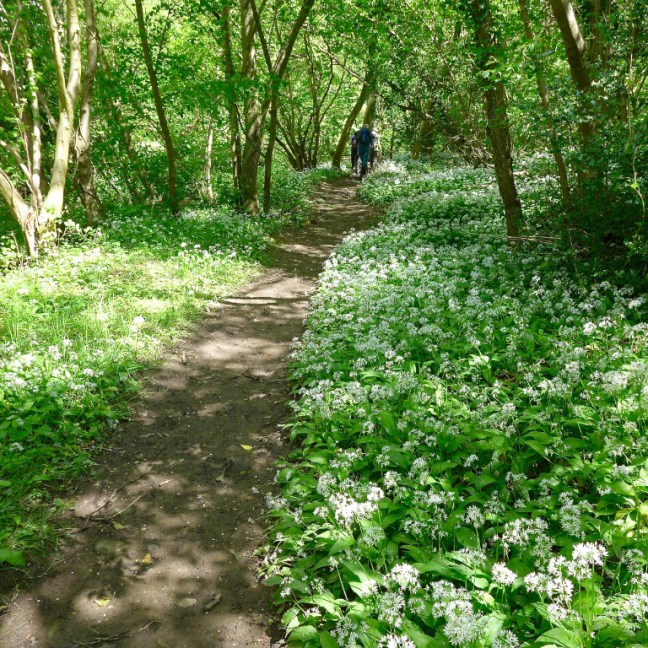
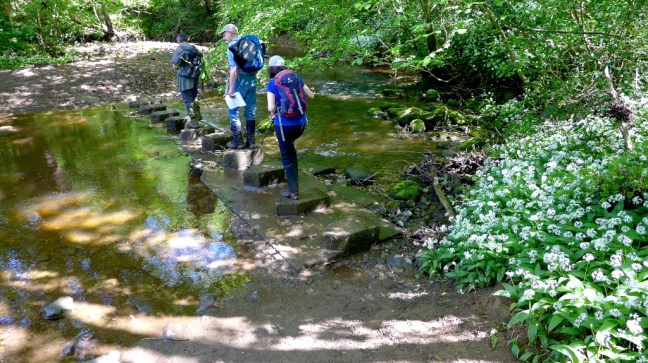
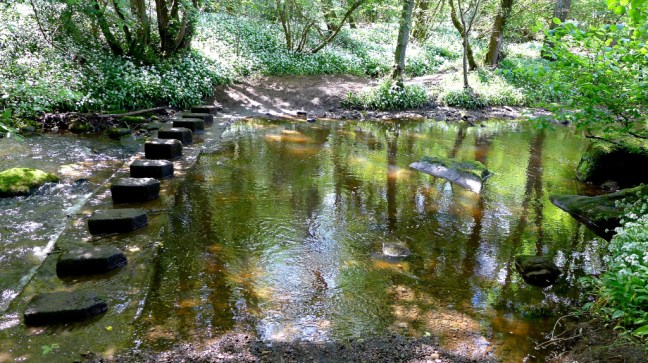
After passing through the hamlet of Littlebeck, we ascended the road leaving Wainwright’s coast to coast before running parallel with Little Beck. The smell of wild garlic was overpowering and if we had stayed I suspect we might have got ‘high’ on it.
We stopped at Sleights station for lunch and were rewarded with a North Yorkshire Moors steam train passing through.
After Sleights, we joined the 80 mile Eskdale Way, which I completed in 2012. It starts and finishes in Whitby and circuits across the Moors to near Guisborough and Baysdale Abbey.
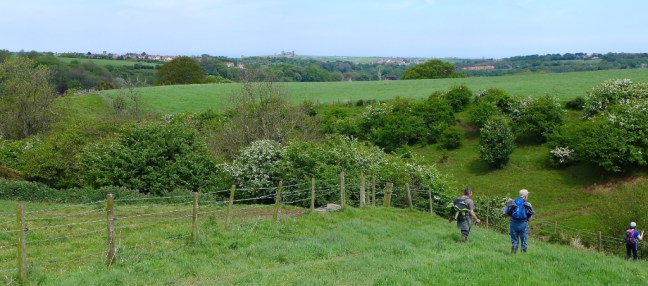
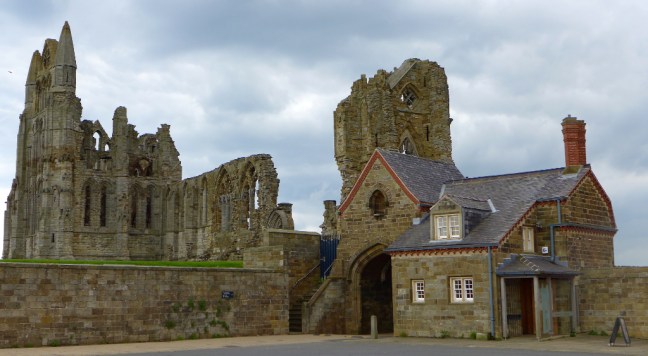
Whitby Abbey the end of our walk came into view in the far distance. Despite a forecast of showers, the weather was holding up with bright warm sunshine.
We arrived in Whitby to unexpectedly come across some friends of Sid and Carol’s who were on a school reunion! One was over from Australia and was planning to continue parts of Wainwright’s Coast to Coast.
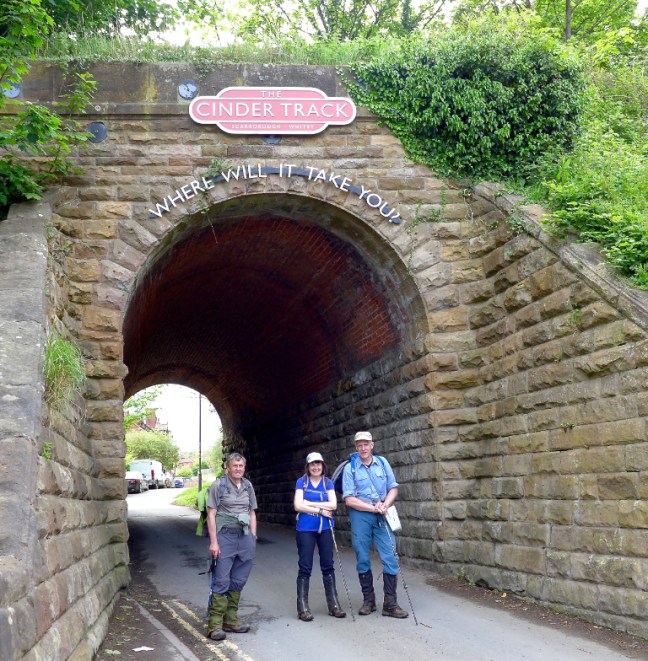
What a small world we live in these days. As shown on the bridge it is a case of WHERE IT WILL TAKE YOU.
Walking through Pannett Park we were accosted by an alligator.
But survived to reach Whitby Abbey, the end of a fine and enjoyable walk.
Now it was off for fish and chips and then to catch the Coastliner bus back to Goathland. Even better, three of us had bus passes. Poor Carol had to pay! With hindsight we should have had a collection for Carol. But the walk was for Christian Aid so we will be donating there!
It started raining just as we started having fish and chips!
Miles Walked 15.1
Steps 31,500
Calories Burnt 1,700
Average Pace 19.12 (but that included the fish and chip shop)
Post 143: 9 April 1997: Day 5 – Keld Youth Hostel to Cotherstone – 17½ miles
Again we woke up to bright sunshine. There is no doubt that global warming is on its way. If any scientist needs proof they only have to read these diaries. Remember the rain and cold on Wainwright’s Coast to Coast in 1991 and the rain, cold, snow and sleet on the Cumbria Way in 1992? Yet here we were, another day when we would be stripped down to our T-shirts, something I never managed in nearly 300 miles of walking in 1991/2.
Soon after passing East Gill Force, we left the area enclosed by drystone walls to enter what can only be described as ‘England’s Last Wilderness’, the bleak Black Moor.
It looked like a greeny-brown moon landscape with nothing, as far as the eye can see, apart from moorland and blue horizon. Now what makes people walk into such a landscape? Is it the isolation, the stark beauty of barrenness, the fresh air, sounds of the skylark or lapwing. Don’t be daft; leaving North Yorkshire and the Yorkshire Dales National Park to enter County Durham, we arrived at the highest pub in England, the Tan Hill Inn.
We were now at 1732 feet, suffering from altitude sickness, and a drink or two was the only remedy. Some Pennine Wayfarers have been known to have camped here for days. Many famous people have commented on the roaring fires in the pub, including Alfred Wainwright, Mike Harding and Hannah Hauxwell. There is always a warm welcome at this pub, one of the most isolated and loneliest habited places in England; it is adorned with postcards sent from visitors from all around the world.
In the past the pub has had associations with mining, packhorse trails and sheep fairs. The Tan Hill Show, held annually near the pub, is an opportunity to meet local farmers and to see Tups, the ram or male species of the Swaledale sheep, being judged; some sheep fetch over £30,000 at auction. Personally I’d rather have sports car for that price to replace my fourteen-year-old Volvo (update – my Volvos are not so old now!).
We eventually dragged ourselves away from the pub taking the route along Coal Gill Sike and Frumming Beck where the sense of remoteness is complete and in bad weather it can be a very serious stretch of walking requiring good navigation skills. In good weather it still saps the energy as you hop and wind over, around and through peat bogs; this is true ‘Pennine Way country.’ The isolated but welcome Sleightholme Farm was reached, then, after crossing Sleightholme Beck and Wytham Moor, easier walking alongside the River Greta led to Bowes.
Bowes became an important coaching centre with the coming of a good turnpike road. Now that the A66 by-passes the village it is a quiet backwater, although a visit to the pub, the Ancient Unicorn, a former coaching inn, and the church of St Giles is recommended. The church is of medieval origins with late Norman north and south doorways. The south porch, added at the bequest of Thomas Woodcock, has a weathered sculpture of the Crucifixion. The church has two early fonts, one of the 13th century resting on a Roman altar and an earlier one having zig-zag decoration. A stone from a Roman building has an inscription to Emperor Septimus Severus. The Romans built their fort of Lavatrae here and the basic grassy ramparts can still be traced. The masonry was incorporated into Bowes Castle – a Norman watchtower or keep constructed in the 12th century to guard the Stainmore Pass.
In the 19th century Dotheboys Hall was a school where the pupils were treated to a life of misery being beaten from time to time, receiving a bad education and invariably having poor health. When I was a child I thought all schools gave pupils a life of misery. Actually that’s not true, although being at school does have its ups and downs. Boarders from Dotheboys could be sent to farms and their earnings given to the Headmaster. The grave of 19 year-old George Ashton Taylor, a pupil of Dotheboys Hall School, was the inspiration for the character of Smike in Dickens’ Nicholas Nickleby and the hall was also used in the novel. Some of Dickens’ information was obtained from the bar of the pub but also from William Shaw, Headmaster of the school, who is also buried in the church graveyard. Part of Dotheboys Hall has been demolished and what is left remains part of a number of private houses.
After some road walking, then passing Crag Hill and Crag Pond, there is a gradual descent to Teesdale and the quiet, attractive, village of Cotherstone, where we called into the post office to try some soft and crumbly Cotherstone cheese. This delightful village stands high above the confluence of the Rivers Balder and Tees. The 12th-century castle on Hallgarth Hill is now just a steep mound with some broken stones. Cotherstone was established as an agricultural community from Anglo-Saxon times and during the 19th century developed more as a commuter and holiday settlement with the arrival of the Tees Valley Railway. The railway closed in 1964 and the village has grown little since then, although it is a popular place to live in. It is one of the most attractive villages in Teesdale and has been designated as a Conservation Area in order to preserve its beauty. The fine church of St. Cuthbert was built in 1881, in the early English style by C. Purdon Clarke.
Hannah Hauxwell lived in Cotherstone. She had television fame when previously living in isolation at Low Birk Hatt Farm, one of the remotest farms in the country.
A substantial meal in the Fox and Hounds Inn replenished tired bodies, and as we sat in the lounge afterwards with our pints we thought we were in for a quiet evening. In the 1998 AA guide to Top Ten pub names, the Fox and Hounds came eighth.
There were three young men at the bar and a striking blonde lady, on her own, dressed somewhat unusually in black, with a colourful scarf around her neck. It didn’t look as though she had been to a funeral as she had walking maps in front of her. Needless to say our conversation got round to walking. Now blondes don’t normally come over to us; we are ordinary middle-aged guys that women briefly look at and then look away as though we weren’t there. To our astonishment this one came over to introduce herself as a walker and professional magician; she was immediately nicknamed Magician Walker. She had a deep voice, prominent jaw and firm wrists.
‘I can see you don’t believe I am a magician,’ she said, ‘would you like a performance?’
‘Err…………. sure.’ we all said disbelievingly, looking at each other and smiling in faint amusement.
‘Can I have an assistant?’
Alan jumped up, clearly out to impress.
‘Has anyone a £10 note?’
There was silence.
‘Come on, one of you must have a note?’
Everyone looked at Alan who relented under pressure to produce a £10 note, handing it over as though his life depended on getting it back.
She put the £10 note in a glass, rubbed her hands over it and then showed us an empty glass. Alan looked devastated.
At that she proceeded to run through a whole host of tricks, making bottles go through wooden tables, cards appear on the pub ceiling, and burnt paper re-appear. She eventually made a £10 note re-appear in the glass. At the end of about an hour’s performance we burst into spontaneous applause. It was tremendous.
It wasn’t until the following June that this performer was mentioned in the Times. The correspondent said two magicians were performing after a dinner at the Waldorf for a company called Financial Objects plc. As he went in there were loud bangs and claps, playing cards slapping on tables, peals of laughter. He saw a huge upturned hat. The magicians were working the room just as Magician Walker had worked us at the Fox and Hounds. The two of them were holding the tables spellbound just as we had been. They did an unbelievable rope trick, then performed a card trick which ended with a card selected by a random diner being discovered thumb-tacked to the ceiling twenty feet above. Like us they did not know how she did it. Magician Walker was described as rather beautiful with a husky voice, generous cleavage, big hands and a prominent Adam’s apple – strangely, ambiguously sexy. It dawned on the correspondent as it did me that she had changed her gender. She used to be Oliver, a motorcycle dispatch rider.
That’s magic!
As we walked back to our bed and breakfast, the evening entertainment was concluded with spectacular views towards the dark skies of the comet ‘Hale-Bopp’, much brighter with us being away from City lights. It was the brightest comet for five hundred years and it is estimated that another one so bright would not be seen for another two thousand and three hundred years. It was formed some ten thousand years previously and was part of the left overs from the development of the solar system. This was indeed a memorable sight
Post 142: 7 April 1997: Day 3 – Buckden to Bainbridge – 10 miles
In the morning, whilst watching wild birds eating food put out by the landlady, we had breakfast.
Fortunately, the day’s walk is short and so my hopefully my blisters would recover. The weather was good as we left Buckden. After climbing the old Roman road of Buckden Rake, we decided not to do the three-mile detour to the summit of Buckden Pike as, at over 2,000 feet, it was unlikely to help my blisters to heal.
Continuing over Stake Moss, there were fine retrospective views of Buckden Pike. A clear track alongside Cragdale provided easy navigation with an opportunity to admire the secluded environs of Cragdale Moor, inaccessible to walkers as there are no rights of way. A pleasant descent followed with expansive views of Semer Water as well as the valleys of Semerdale and Raydale. After passing through the quiet hamlet of Stalling Busk and the ruins of the old church, the banks of Semer Water were reached where we took the opportunity to stop for refreshments in what is real Dales country.
On leaving Semer Water, we followed the River Bain, at 2 miles in length England’s shortest named river, into the village of Bainbridge. Here was an opportunity to replenish food stocks and enjoy the wide-open spaces of the village green. In particular, Dick’s mother arrived with a huge, gorgeous, fruit pie, which we completely devoured like starving hyenas. There was also a fine old pub, the Rose and Crown, and sure enough, sitting outside, were Alan and Archie, joining us for the next part of the walk. Bainbridge is the crossroads of this walk and On Foot From Coast to Coast – The North of England Way, my 200-mile walk from Ravenglass on the west coast to Scarborough on the east coast. On reaching Bainbridge, coast to coasters will have walked just over 92 miles compared to our 30 miles.
8 April 1997: Day 4 – Bainbridge to Keld Youth Hostel – 10 miles
As we left this lovely dales village in bright spring sunshine, my feet were somewhat better, but by no means completely healed. After some gentle walking, Askrigg was soon reached where we passed Skeldale House, the surgery-home of Siegfried Farnon, his brother Tristan, and James and Helen Herriot, in the BBC television series ‘All Creatures Great and Small.’
We headed north from Askrigg and, on crossing Askrigg Common, the limestone plateau of Oxnop Scar came into view, followed by the narrow, winding Swaledale valley, surrounded by vast open moors. On reaching Muker, we stopped for refreshments to savour the unique atmosphere of this quaint village nestling between the River Swale and Straw Beck. In fact it was so warm, for over an hour we sat sun-bathing on a bench in the centre of the village. The village marks the point where Swaledale changes in character from a sheltered Dales valley to the upland Dales valley of Birkdale.
Muker
St Mary’s church was first built in 1580 but the present structure largely dates from 1890, whilst the Literary Institute dates from 1868. At this time lead-mining was prevalent in the area. The district around Muker inspired the Kearton brothers (Richard, 1868-1928 and Cherry, 1871-1940), who went to the village school in Muker, to devote their lives to watching wildlife, pioneering the photography of birds and animals, and writing and lecturing about their experiences. They are commemorated by plaques on the chapel.
For tourists and motorists visiting Swaledale, Muker is often the end of their journey as the roads become distinctly more remote and difficult to negotiate. For walkers the next section to Keld is pure delight, especially in June when the hay meadows are at their best with carpets of yellow, blue, purple and white flowers. Just before the Swale passes though a narrow gorge, I have seen deer pass in front of me, from one side of the valley to another. After passing through this Arcadia, we omitted a short detour to visit Kisdon Force in order to allow my feet to fully recover.
Arriving at Keld, we visited a café for a relaxing rest sitting outside in bright sunshine, before proceeding to the youth hostel, a former shooting lodge, and now an overnight stop for four long-distance walks. Keld’s unique remoteness is now offset by it being the crossroads of Alfred Wainwright’s Coast to Coast Walk, the Pennine Way, the Herriot Way and this walk; it is the ‘spaghetti junction’ of long-distance walks. Two chapels, the school and the youth hostel are the main buildings of note in the village, but the Quakers were instrumental in closing the public house.
At the hostel there was an opportunity to swop stories of our experiences with some Pennine Way and Herriot Way walkers.
‘Are you doing the Pennine Way?’ I said to a lady with bright ruddy cheeks which clearly indicated she had been walking along England’s backbone.
‘Yes, I am doing it in celebration of my fortieth birthday.’ She replied somewhat embarrassingly, not really wishing to give her age away to a complete stranger.
‘Your fortieth birthday?’ I exclaimed in complete disbelief. Two-hundred and sixty thousand walkers use the Pennine Way each year, but it was the first person I had met doing it as a birthday celebration.
‘Yes, I’ve never done a long-distance walk before and it seemed like a good idea,’ she said quite genuinely. ‘My companion has done it before and he is looking after me.’
My thoughts went off in a tangent; perhaps they were eloping, having an affair, or something even more interesting. Now a trip to Jamaica, Barbados, Fiji, Australia or New Zealand might be one thing to do when your forty, but to do the Pennine Way is another. Why walk through mud, peat bogs, rain, mist, and winds as a celebration of your fortieth birthday? I might have understood her reasoning if she had been Japanese. Their game show Endurance, where they have maggots crawling over them, lizards running at them and such like, indicates they enjoy suffering. However, she was as English as they come and, as we all know, the British like to see no more suffering than a couple on Blind Date reporting to Cilla Black how they had an awful time on their date and hate each other.
‘Are you enjoying the walk?’ I asked knowing that, if she answered the question incorrectly, all would be revealed.
‘Oh, yes, it’s tiring but I am enjoying it.’
That was it. No one enjoys the Pennine Way, she was clearly in love with her companion, although I never did manage to prise open their exact relationship. She was clearly out to grab her man by accompanying him on the Pennine Way; the birthday was just an excuse.
Also staying at the hostel was a seventy-three year old walking the Pennine Way. There are not that many other activities that you can still do at seventy-three. How many footballers, tennis players, golfers, cricketers do you see over sixty, let alone seventy? Rugby players and climbers seem to retire even earlier, usually with some form of injury. To be fair the pensioner had been a fell-runner for most of his life and for him walking the Pennine Way was not unlike walking to town to get his pension. Like most pensioners, it just takes longer to walk from A to B, but like the proverbial tortoise they get there.
There is little doubt that walking can be a lifetime activity and as you get older you can adjust your daily mileage. In order to maintain fitness it is best to increase the amount of activity that you do. On reading that Kate Winslett, star of the blockbuster movie Titanic, does two hundred sit-ups a day, I increased my level from thirty-five to two hundred a day. This had an immediate impact on my midriff bulge, so that my belt could be pulled in a few notches and it was easier to climb steep hills.
Another character at the hostel was a middle-aged man, walking the Herriot Way, who clearly relished the fact that this was the first time he had escaped from his wife and family for years. He said his wife was delighted to have got rid of him for a few days. Little did she know that the Herriot Way has a reputation for ‘matchmaking’, attracting as it does an even proportion of males and females, unlike the Pennine Way, which is male dominated. One can’t help wonder whether, after this walk, his marriage became another divorce statistic or was saved by it?
With the forty-year old having an affair, a pensioner, a wife escaper and no pub for miles, we had a quiet but interesting night and the coal fire was warming and relaxing.
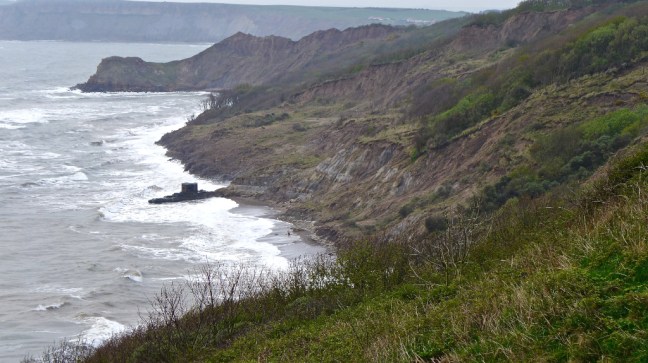
One of the good things about a Bank Holiday is that many people have a lie in and so leaving York at 7.30am the traffic was very light. This was the penultimate walk of the Cleveland Circles walk we had started on 11th October 2016. We were soon walking from Holbeck along the dramatic coastline. An isolated pill box appeared below us.
A mile into the walk I had completed 400 ‘boot’ miles of the Country Walking Magazine 1,000 mile 2017 challenge I am undertaking. I am just ahead of schedule.
Many of our former sea defences are disappearing into the sea!
After walking inland at Blue Dophin Holiday Park to near Cliff house Farm we circled back towards Cayton Bay for lunch.
Whilst having lunch between the rocks we waited in hope that the sea would retreat so that we could walk along the whole of Cayton Bay Beach.
Sure enough, with perfect timing the sea withdrew (not quite a ‘Moses Red Sea moment’ but close), to enable us to walk along Cayton Bay Beach.
Before turning again inland to Osgodby.
A Scarborough golf course signalled that we were nearing the end of our walk.
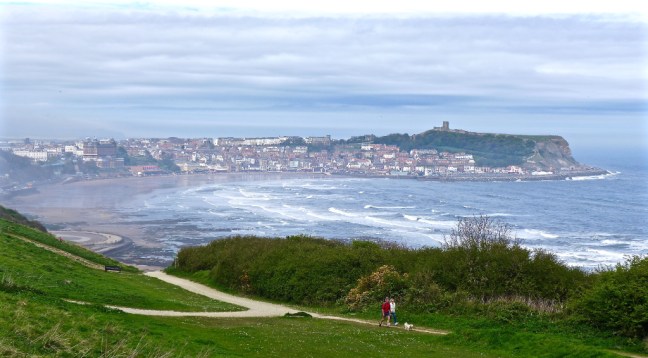
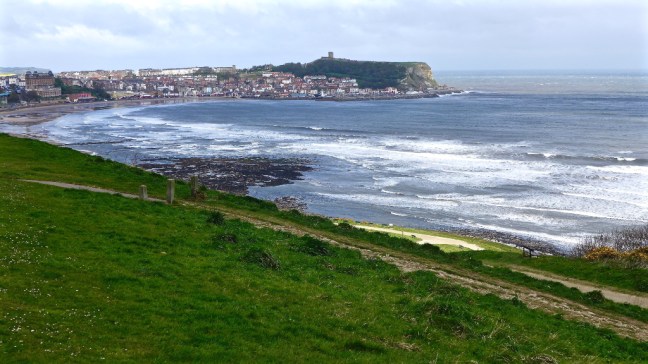
There were fine views of Scarborough at the end of the days walk.
Due to various commitments we decided, at the last minute, in the morning to go to Scarbados (Scarborough) and walk what we thought would be an easy 9 miles around Scarborough (known also as Scarbados). So we left York at 11.00am instead of our usual 7.30am. We arrived at the car park near where the Holbeck Hall Hotel used to be until it fell into the sea. This should have been a hint of things to come as it was fairly breezy, it had just started raining and the sea was a bit rough. One of our destinations, Scarborough Castle, could just be seen in the distance.
We donned waterproofs, including winter gear and over-trousers, and we were soon to find we were probably the only people adequately dressed for the conditions to come. Umbrellas were a no no in the wind.
It wasn’t so bad walking inland through town and past Queen Victoria
and past a memorial seat to soldiers.
A steep climb then followed towards the church going past Butter Cross, a sole surviving medieval street stone.
St Mary’s Church
Near the church we found the gravestone of Anne Bronte who died at the very young age of 29 (not 28 as previously shown on the old gravestone).
We passed Scarborough Castle to be hit be really strong winds, nearly getting blown over.
However, it was worth gaining height for the views towards North Bay.
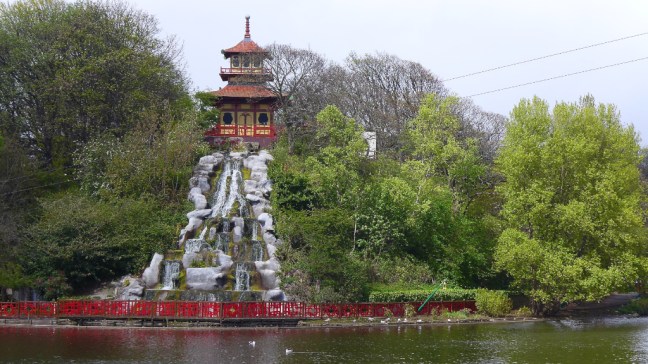
Some relief from wind was gained when we descended to Peasholme Park. This opened in 1912 and attractions include an atificial boating lake, mock naval battles and a putting green.
A little further on towards the Sea-life Centre we passed the miniature railway line.
The headland is protected from the sea by gneiss rock from Norway. However, there was little to protect us from the heavy wintry showers, at times stinging hail, and high winds. We would soon pass below Scarborough Castle shown on the headland. William de Gross started to build the castle in 1140.
If you don’t keep moving you can end up like this poor chap.
After heading around the headland we came to South Bay with its rather gawdy amusement arcades. We passed in front of the Spa which originated in 1626 when Mrs Tomyzin Farrer claimed that the local spring water had health giving properties. ‘Spaw House’ was built in 1698 by Dickie Dickinson. It 1826 the ‘Spaw’ became the Spa. It has been improved and made more secure against the sea over the years.
Moving on quickly we suddenly realised our route back to the car park was blocked by the sea.
Sid the Yorkshireman said ‘we could run through between the waves’. I think he was joking!
We retraced some steps and ascended further up the cliffs before rejoining the main Cleveland Way to lead us back to the car.
So Theresa May goes walking to the west, Snowdonia in Wales, and ends up calling a snap General Election. That is Power Walking.
We decided to go East and ended up making no decisions at all, other than whether we should have an ice-cream or not at the end of our walk.
Now would Theresa’s decision have been different if she had walked my North of England Way, which I know she has a copy of? It is of course top secret as to how she got it as these are Secret Diaries.
So heading out East to Scalby (pronounced Scorby according to a local) we started walking at 8.45am on Cleveland Circles and coincidently theNorth of England Way. Our first stop was at Scalby Parish Church, dedicated to St Laurence.
There is a plaque in the churchyard dedicated to a very brave lady who died trying to save passengers of the Whiskey Echo.
We continued inland to Prospect Farm where the prospect of entering a field with these long horned cattle put fear into Carol. Fortunately, we were able to avoid them.
There were lovely views back to Scarborough Castle and a couple of deer suddenly startled us, one jumping the barbed wire fence.
We eventually reached the coast and the Cleveland Way,
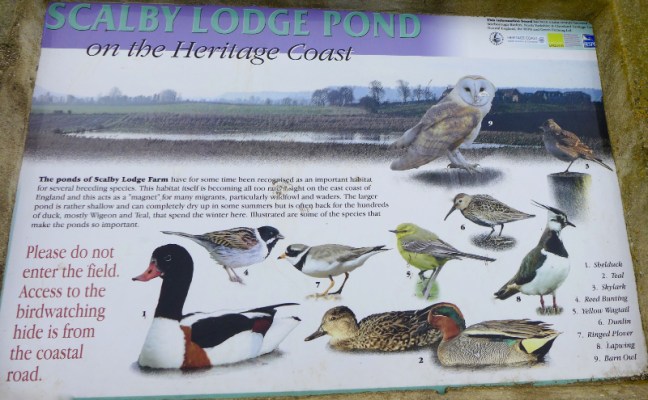
before passing Scalby Lodge Farm pond which was largely dried up, symptomatic of the dry weather we had been experiencing recently.
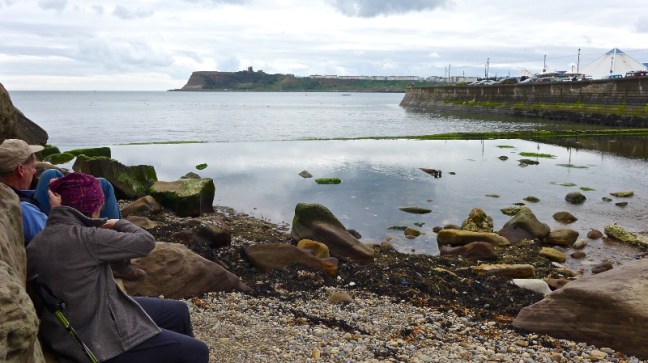
Our final view of the coast was at lunch time just below Scalby Ness.
Then it was mostly tarmac walking back to the car. It was then off to an ice-cream at Hackness (see previous blogs). Much more enjoyable than a General Election. Perhaps Theresa should have gone east?
Now I think in the election we are going to get a lot of rhubarb, rhubarb, rhubarb and more rhubarb from politicians, so I had Rhubarb and Ginger ice cream, imported into Yorkshire from Suffolk. It is midway between sorbet and ice cream but very refreshing after a long walk.
Miles Walked 11.14
Calories Burnt 1,300
Steps 21,900
Average Pace 18.12 Minutes Per Mile
Fastest Split 17.41 Minutes Per Mile between 8-10 Miles
We left York with low expectations at 7.30am on a Bank Holiday Monday as the forecast was for cloud and some rain. The roads were completely empty of traffic at this time and on this day, which meant we had a good journey along the A64 to Burniston, north of Scarborough, the start of our walk. The skies were blue and the sun was out.
After walking along the dismantled railway line to Cloughton we walked through some pleasant largely unexplored countryside for several miles. No other walkers were seen.
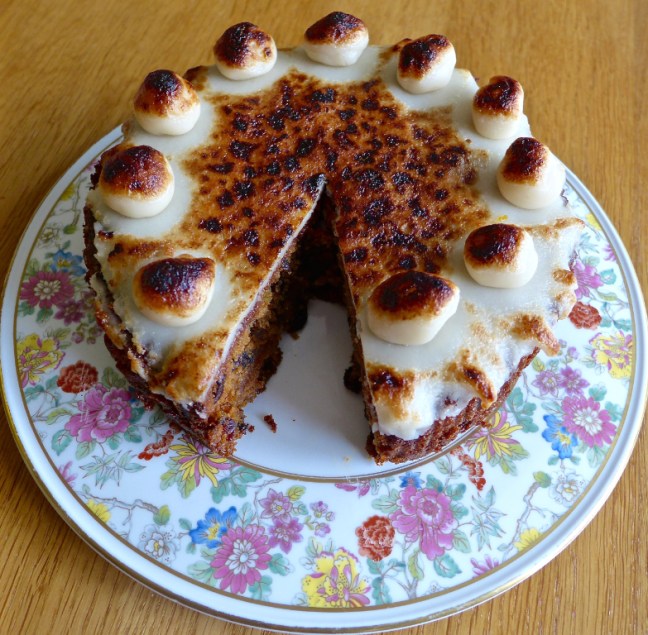
We stopped in a quiet pleasant woodland for coffee and homemade Mary Berry Simnel cake. A real energy boost!
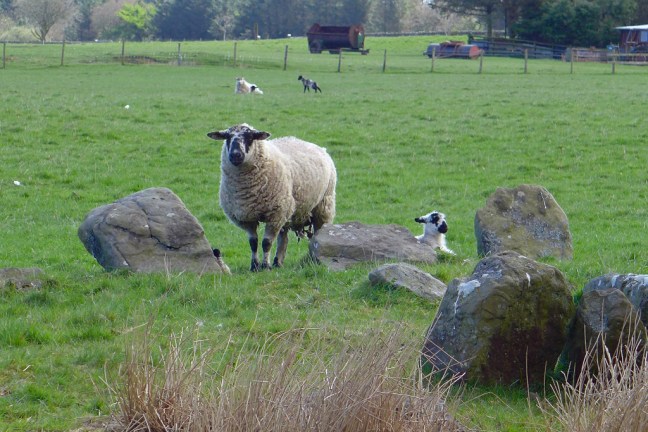
The first notable location of interest were some standing stones at Rigg Farm. Our guide book said this was the property of Anne Tiffany who had given permission for Cleveland Circles walkers to cross her farmland in order to view this ancient monument. This small stone circle is believed to have dated from the Late Neolithic to the Bronze Age (about 2400-1000BC). It is believed that it was a focus for burial rites.
There were originally 24 earth fast stones, but now there are only 15.
As we walked near the farm, the farmer Chris Chapman came out to greet us. His wife Anne Tiffany (she kept her own name) had passed away a number of years ago and didn’t want to be buried at the stones. Instead she was laid to rest alongside the drive from the farmhouse in a modest grave, which was her wish. He was more than happy to allow walkers to continue visiting the site of the stones.
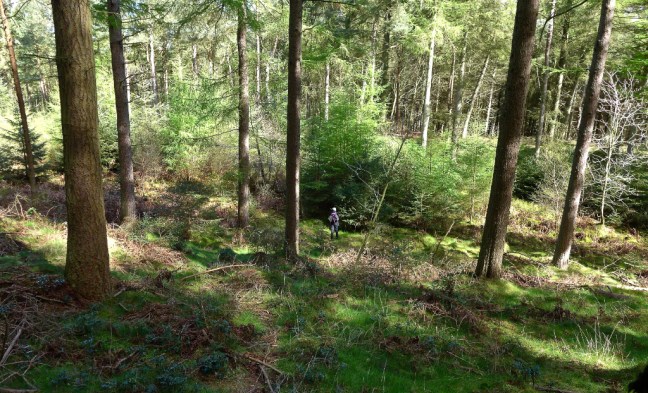
Leaving the A171 we entered some tricky woods to descend to Cloughton Moor House.
Following a track, great views towards the sea appeared. Still no other walkers
We were surprised to come across a lonesome post box, nowhere near any particular village.
We eventually reached the coast near Hayburn Wyke for stunning views, many of them looking back. It was around here that my batteries on my mobile phone expired and my Map My Walk app stopped working. Maybe I hadn’t fully charged it the night before.
Views forward were stunning too, including Scarborough Castle in the distance. Other walkers were seen on this section of The Cleveland Way.
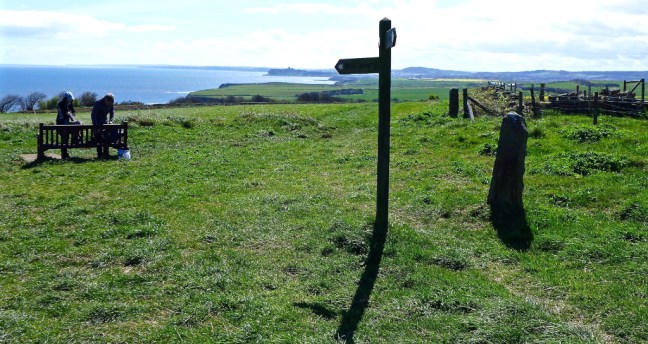
Then we came across a long awaited bench for lunch with a fabulous panoramic view in the sun. It doesn’t get much better than this, especially when we had expected rain. Clouds were forming over land, but not where we were on the coast.
Thank you for the life of Ann Hazell and for the bench.
We continued to Cloughton Wyke.
With explosions of colour.
And again great views back. I sometimes think I should walk backwards.
We passed the Long Nab Coastguard Station now a bird-watching hide.
Scarborough Castle was getting nearer.
We arrived at Crook Ness where there is a fine information board. Sid the Yorkshireman points out that it was partly paid for by EU money. Or is that our money we give to the EU who then hand it back to us?
On that note it was a short walk back to the car and the end of a fine walk. We had hardly seen any traffic or walkers and had truly ‘got away from it all on a Bank Holiday‘.
Taking the ‘country route’ back to York, disaster then struck as the ice-cream and cider shop (see previous blog) at Hackness was closed. We had to settle for buying our eggs from a farm.
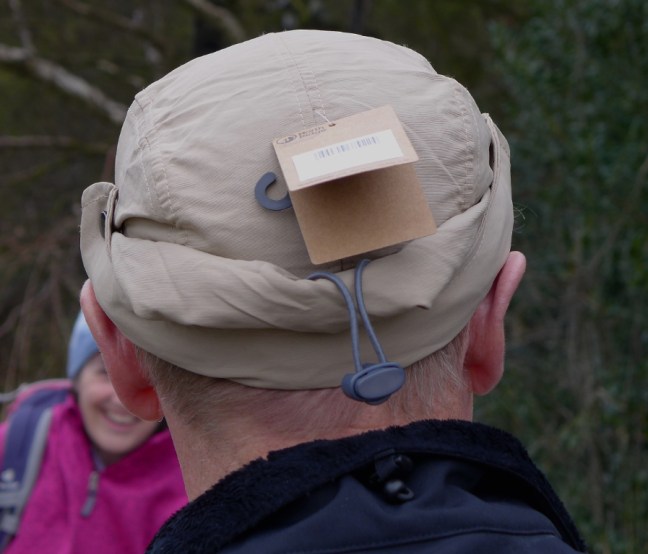
You will recall from previous blogs that Sid the Yorkshireman has a propensity to lose hats and occasionally find them again. At the last count is was about 30 hats, or maybe I exaggerate slightly – perhaps 3 hats. Having lost his Lawrence of Arabia sun hat he turned up at the start of our walk at the Falcon Inn, just off the A171, at 9.00am with the replacement summer hat. Trouble was he had forgot to take the label off or was he deliberately keeping it on so that if he didn’t like it he could take it back?
The next problem was that near the coast it was colder than York so he reverted back to his winter hat.
Now Sid is not the only walker to have hat problems. Due to the fact I have so many zips in my outdoor gear it is not unusual for a hat to disappear for a while into a zipped pocket only to re-appear again in a month or two. In the meantime I may have purchased another hat. At the last count I had 6 Spring/Summer/ Autumn hats, including a decorating hat (rarely used as walking is much more fun than decorating), and about 5 winter/other hats!
We frequently come across hats and gloves that have been lost by other walkers on walks. I think the hat saga could run and run…..
It is not only hats that go missing. We soon arrived at the location of the Three lords’ Stones. However, we could only find two. Now it is understandable for a hat to go missing, but surely not a stone which must weigh a ton?
We were soon heading towards Ravenscar to have our first stop and a coffee break outside the National Trust shop.
The rather splendid building in the distance on the left was built in 1744 by Captain William Child. It was opened by a development company in 1895 as a hotel. To the right of the hotel is the ‘Peak’, known since 1897 as Ravenscar. This was the town that never was.
Some of the bricks in the paths have RAVENSCAR embedded in them. The Whitaker Brick Company started making Ravenscar bricks in 1900 to be used for the construction of a proposed new seaside holiday resort. However, when potential investors for the resort arrived by train they were not impressed with a resort miles from any sandy beach and with 630 foot cliffs below it. The development company Ravenscar Estate went into bankruptcy in 1913 and the resort was not built.
We left the town that never was to follow The Cleveland Way.
Many dinosaur footprints have been found in the cliffs hereabout.
We soon came across the remains of a radar station, which has built in 1940 to detect German planes and ships. There was no mention of it detecting lost hats.
Fine views soon opened up towards Scarborough Castle, which can just be seen in the far distance.
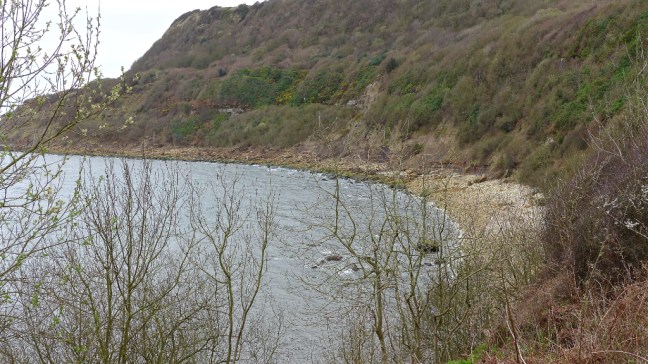
We had a steep descent to Hayburn Wyke, which made a good sheltered lunch stop, even if a little noisy from the waterfall.
Climbing up steeply from the beach we came across knarled and twisted trees.
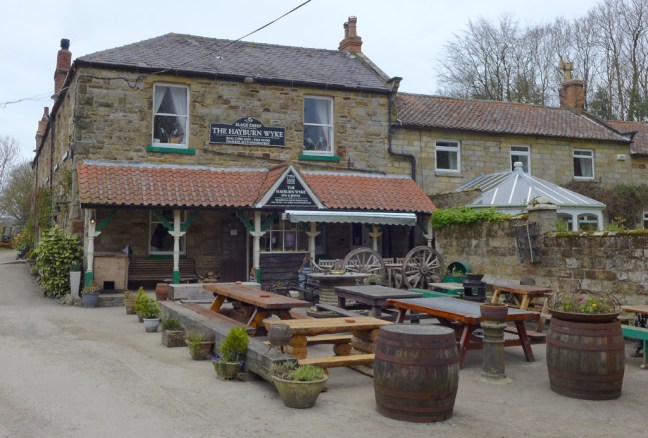
Until the Hayburn Wyke Hotel was reached
With its horseshoe arch.
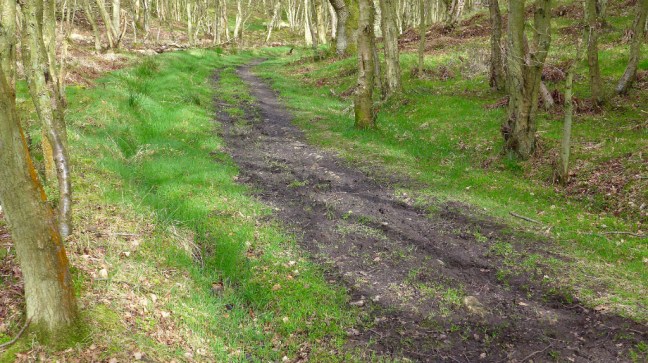
After some confusing route finding near the dismantled railway track (not our fault) and between Claughton Moor House and Prior Wath, we emerged from some very boggy ground to find an old limekiln.
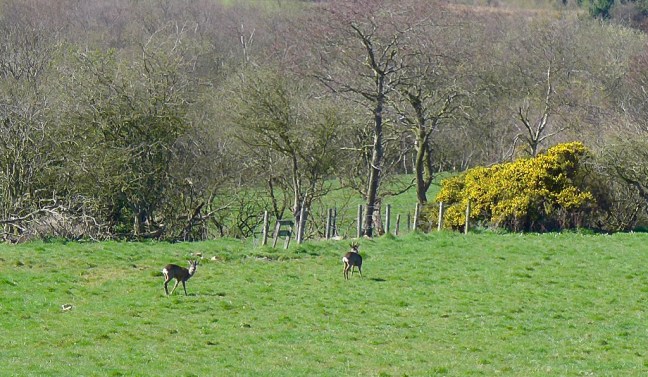
Near the end of the walk we saw two deer.
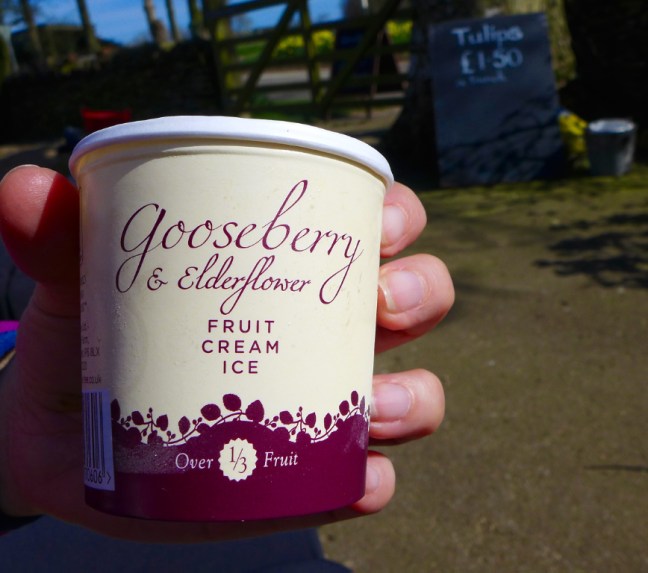
Driving back we came across a delightful oasis of food, home produce, organic vegetables and whole foods as well as various drinks including real cider. This was near the junction at Suffield near where The North of England Way passes. The cider and farm shop has particularly tasty ice-cream and its own Tabular Hill cider. Well worth a stop if in the area.Their website with opening times is: WWW.TREETOPPRESS.CO.UK
Tel 01723 363 731.
Miles Walked 11.73
Calories burnt 1,300
Steps 24,900
Average Pace 19.47 Minutes per Mile
Fastest Split between 6-8 miles 18.24 Minutes per Mile.
With a great forecast for the day we were surprised to encounter drizzle as we headed across the moors to Ravenscar to arrive at about 9.00am. It was a bit cloudy and cold when we started putting our boots on. As we ascended the first hill we could just see Robin Hood’s Bay in the distance.
After some moorland walking we arrived at Cook House to find a fairly unique collection of anvils.
Also a clever adaptation of a telephone box for storing of wood.
And a knight in armour.
The mottled lambs hereabouts were very cute.
We then entered a delightful woodland area and a deer ran across our path. It was too quick to capture on camera.
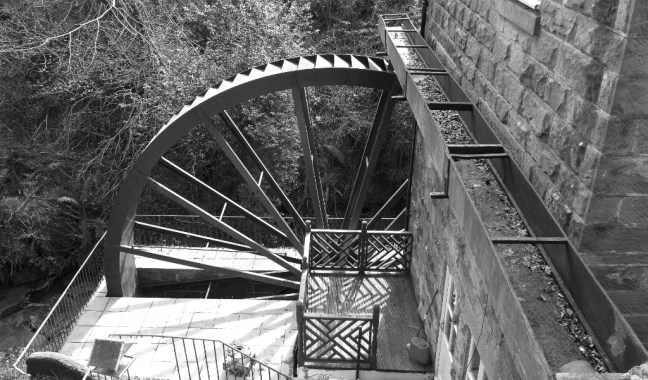
We then arrived at Ramsdale Mill Farm. It is believed that there has been a mill at this site since 11th century. The present mill was commissioned in 2003 and is intended to provide hydro-electric power.
The views towards the coast from the track leading away from the mill are superb. Ravenscar where we started can be seen on the farthest hill.
We were heading towards Boggle Hole for lunch on the beach. Before that we passed Fylingthorpe Public School and soon after the path enters the garden of someones house at Sunnyside. There is a dog that barks and if you are lucky the owner of the property comes out and is more than happy to have a chat and explain about the history of the area. She has lived there since 1948 and her Aunt formed the school. She will tell you about the history of the school and about how the water supply to her house has been somewhat intermittent in the past and not always pristine pure having come from springs higher up. There is also a barn which had its roof raised from the original thatch and she will take you inside to show you where the roof was originally.
We descended down to the Cleveland Way path.
At Boggle Hole there is a Youth Hostel, which used to be a former corn mill and it is possible to obtain refreshments there. In the past it was a haven for smugglers.
After a steep climb out of the valley we resumed our walk along the Cleveland Way. It was essential to keep looking back towards great views in the direction of Robin Hood’s Bay.
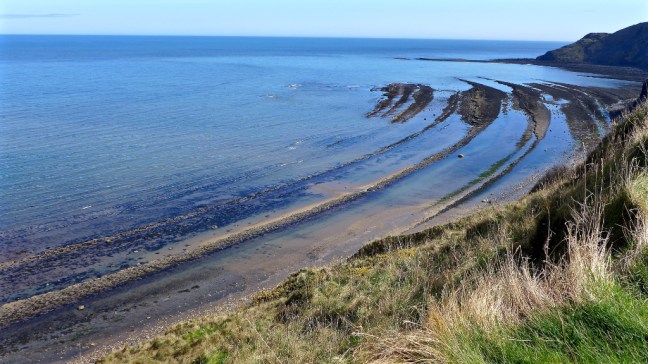
However, the views forward are superb too, showing a wave cut platform. It is the remains of a huge dome structure centred on the bay. The sea has eroded the structure to reveal the layered rock. This area is of international importance for fossil records with more than 250 species of fossils being identified from 600 beds.
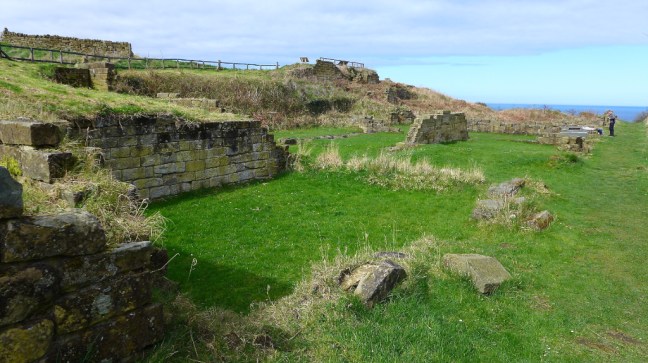
We arrived at the remains of the Alum Works. Quarrying started in 1650 and continued until 1850. In its peak in 1768 over one hundred thousand tons of rock a year were dug out by pick axe and moved in wheelbarrows along the manufacturing line!
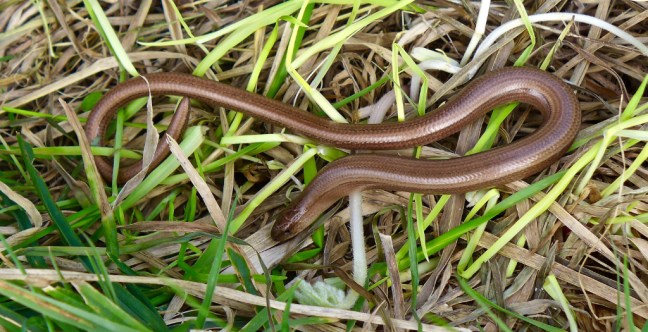
Here we found a slow worm.
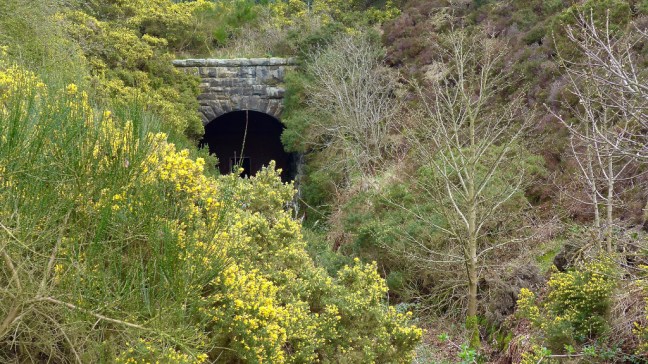
The final section of the walk is a fairly unrelenting climb. Just before we got back to the car we passed a tunnel, which which was built to divert trains away from the nearby hotel. The tunnel diversion cost £500. The railway from Robin Hood’s Bay was opened in 1885.
Miles Walked 11.22
Calories Burnt 1300
Steps 23,600
Average Pace 19.26 Minutes per Mile.
Fatest Split at 8-10 Miles, 18.58 Minutes per Mile.


















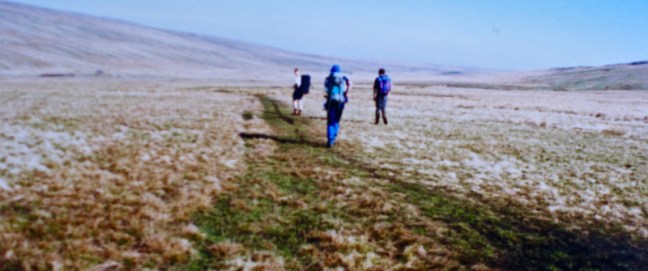 It looked like a greeny-brown moon landscape with nothing, as far as the eye can see, apart from moorland and blue horizon. Now what makes people walk into such a landscape? Is it the isolation, the stark beauty of barrenness, the fresh air, sounds of the skylark or lapwing. Don’t be daft; leaving North Yorkshire and the Yorkshire Dales National Park to enter County Durham, we arrived at the highest pub in England, the Tan Hill Inn.




























 secretwalkscom