Post 161: 14 April 1998: Day 3 – St Just to Pendeen – 7 miles
Leaving the hostel next morning I soon arrived back in St Just, this time venturing to explore something other than the pubs. Sturdy windswept granite houses surround the market square, which in summer can get very busy. I headed for the quite large parish church named after a 6th century Christian missionary Justus. Just inside the entrance gate is the old Market Cross, from which the sexton would read the notices after the Sunday services. Outside the church doorway are the remains of a wayside cross, which were placed along funeral routes where rest, prayers and hymns took place. Over the entrance to the church is an 18th century sundial. The hollow stone in the porch is believed to be the font from the ancient oratory at Cape Cornwall where I would soon be heading. Of particular interest on the interior north wall are two medieval wall paintings, one of which represents the wounded Christ surrounded by tools of the period, entitled ‘A warning to Sabbath breakers’, and the other which represents St George and the Dragon. From the church I walked opposite the town clock along North Row to the last cottage, which was an original meeting place of the Methodist Society where John Wesley preached. I then proceeded to Chapel Street where stands the old Literary Institute which was founded in 1842 as a library and lecture hall and later became the Lafrowda social club; it has a neo-classical facade. Further along was the Wesleyan Methodist Church built in 1833 to accommodation a congregation as high as 2,000. Returning to the clock I passed it to the grass-covered amphitheatre known as the Plen an Gwary, which means ‘playing place’. Until the early 17th century the site was used for performing medieval miracle plays. The large block of granite show the marks made during hand-drilling competitions organised by miners in more recent years.

From the Plen an Gwary I followed the road towards Cape Cornwall but turned off at the Great Atlantic Map Works which frequently exhibits local art work including the much acclaimed paintings of Kurt Jackson who stunningly captures the special light and atmosphere of the area. As I proceeded along Bosorne Road looking back over Cot Valley I could see the Youth Hostel amongst windswept trees. Ahead were the twin rock islands of the Brisons. The lane soon became a track passing between restored ventilation shafts and mine stacks until the remains of a Late Neolithic to Middle Bronze Age (2500-1500 BC) burial chamber, Ballowal Barrow, came into view. Continuing to the summit of Carn Gloose there were outstanding views back towards Land’s End.

A little further around the headland the path started to descend steeply and the distinctive Cape Cornwall appeared in front of me rising to a summit with a mine stack perched on the top.


It was not unusual to get birds blown onto the Cape in storms. This pied wagtail was one of the local residents.

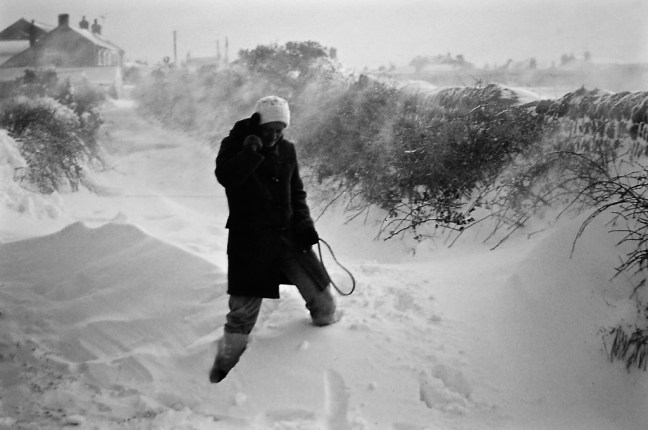
Celia near Cape Cornwall in Winter. it was very rare to get snow and it quickly thawed.
The view from the back of our house.

Reaching the base of the Cape a sign indicated that it was bought for the nation by H J Heinz Ltd in 1987 and was then presented to the National Trust to mark the company’s centenary. I climbed the steep path to the mine stack which was part of the 19th-century Cape Cornwall mine. Below me to the south, the beach of Priests Cove was littered with pebbles and boulders with small fishing boats tied to the slipway. Each summer there is a swimming race from the Brisons to the Cove – some three-quarters of a mile and a test of considerable fitness and stamina.
I descended the Cape to a small building, St Helen’s Oratory, partly restored by the National Trust its walls are believed to incorporate masonry from an original early Christian building. There are also two gravestones in the field, one of which has a number of toys surrounding it and sadly is the grave of a child, the other being the grave of a local golfer who played at the Cape Cornwall Golf Club across the lane. Above the golf course is a huge barn that has been converted into holiday flats, in which we have stayed for our annual summer holiday for many years.

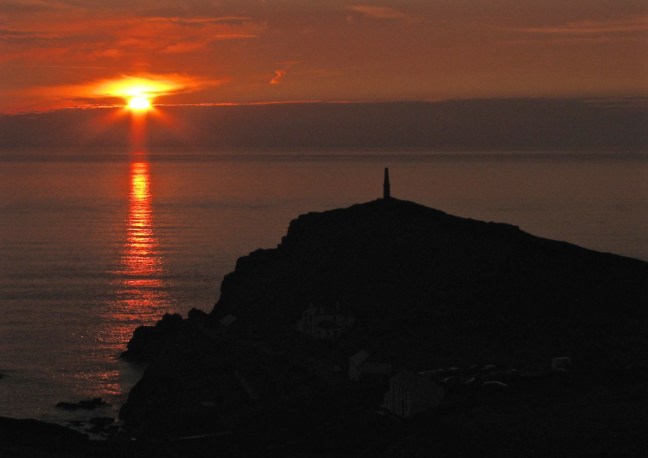
The view from the flats is breathtaking especially during sunsets over the Cape, resulting in me writing the following poem:
A view from the window
Sun piercing glazed sea and woolly sky
A quilt of fields entombs golfers as they try.
The house martins dance and weave in delight
While the redpoll hops from green to green.
Cars snake along twisted lanes
As walkers ascend the chimney trail.
Cape Cornwall stands proud and erect
While Atlantic waves crash against darkened granite,
Perfect.
I left the field to pass the car park and then turned left to follow the coastal path to Kenidjack Valley.
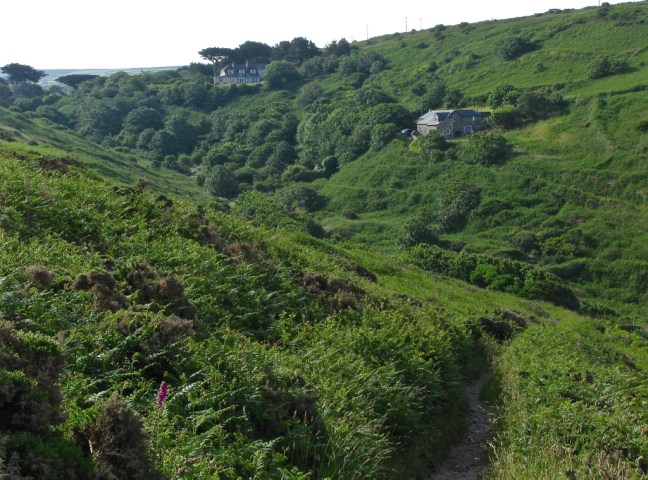
There are numerous mining remains within the valley including a huge wheel pit and an ancient calciner for extracting arsenic from tin ore, to both purify the ore and to collect the arsenic powder for sale as pesticide. Water power was used extensively here for mining purposes. The National Trust has carried out much restorative work including reinstating a typical reservoir, which would have supplied the tin mines with water. The southern slopes of the valley are traversed by the dried up courses of leats – narrow channels, which carried the water.
After crossing Tregeseal River and passing some isolated cottages, I took a path off right, which ascended the other side of the valley.

The path straight on leads to the sea and some twenty years previous was a favourite walk of my wife’s and mine during our four years residence in St Just. On one occasion, despite coastguard warning flares being set off I saw a German tanker pass between Cape Cornwall and the Brisons, missing rocks and disaster by only four feet.
At the top of the path I turned left to view the remains of what used to be travellers huts, perched on the cliffs at the mercy of Atlantic storms until the local council forced them to move on. It is incredible that they managed to live in such a harsh setting.


I returned to the main coastal path and ascended to the promontory of Kenidjack Head with its well-defined Iron Age bank-and-ditch defences. Inland are the remains of shooting butts, dating from the mid-nineteenth century but in use until the end of the last war.
I now headed northeast on more level ground towards the engine houses of Wheal Edward and West Wheal Owles.
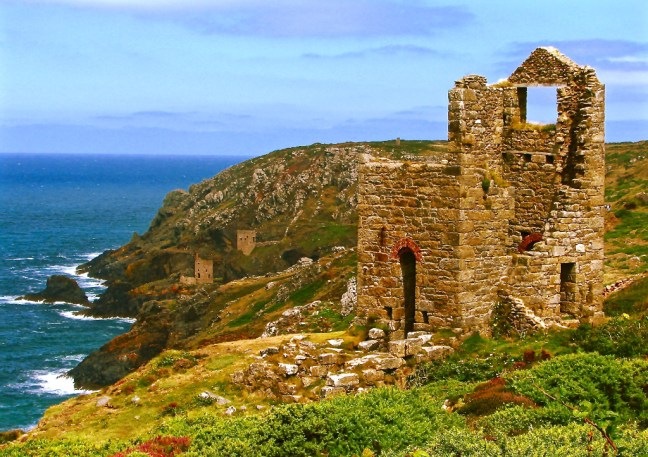 At the latter in 1893 miners broke through into abandoned, flooded workings of Wheal Drea and 19 men and a boy were drowned. Continuing through the industrial wasteland I passed the Botallack Arsenic Labrynth, which is part of a 19th century tin mine. To the left was one of the most dramatic viewpoints in England where the Crowns engine houses sit perched on cliffs above ferocious seas. It is said that when miners went to the underground passages under the Atlantic they could hear the waves crashing above. The Crowns are part of Botallack mine, which was worked before 1721 and closed in 1914. The lower pumping house was built in the 1930’s and the upper working house in 1858. Both were preserved in 1984 by the Carn Brea Mines Society with the help of many individuals and authorities as a tribute to the past generations of Cornish miners.
I continued on the coastal path to the Levant Engine House with its steam engine restored for the National Trust by the Trevithick Society.
 This is the oldest beam engine in Cornwall and after 60 idle years is steaming again. It was built in 1840 and the 27 inch engine hoisted ore from the Levant Mine. Miners used to climb down small stepladders to over 2,000 feet underground. Life expectancy in the early days of the mines was only 35 years until improvements in conditions took place including the provision of ventilation. It produced copper and tin ore until its closed in 1919 after 31 miners were killed.
I then headed inland towards Geevor tin mine. This was the last mine to remain in production late on into the 20th century. Geevor closed in 1990 despite considerable efforts by the local community to keep it open. It is now an outstanding Mine Heritage Centre and I couldn’t resist an informative underground and surface tour of the workings. The old mine workings are scattered throughout the area and give a sense of the drama, history and mystery of mining that is endemic here.
I then returned to the coastal path as far as dramatic Pendeen Lighthouse situated on the slate promontory of Pendeen Watch. The lighthouse came into service in 1900. There have been many wrecks in this area and in January 1939 seven of the eight-man St Ives lifeboat crew were killed as well as all the crew of the collier Wilson, which sank in Wicca Pool.
Just along from the lighthouse and, after viewing Portheras Cove,

I climbed steeply away from the dramatic and dangerous coastline to Pendeen Manor Farm, a 16th-century building of great character. In the yard is a good example of an Iron Age (1st century BC) underground chamber called a ‘fogou’. The name derives from the Cornish word ‘vau’ meaning cave. Such structures may have been used as storehouses for food and artefacts. The Pendeen fogou suggests that Manor Farm lies on the site of an Iron Age village.
My bed and breakfast for the night was in the exposed village of Pendeen. However, there were two pubs and in the first one, the Radjel I met the local story teller Hartley Hancocks who claimed on 17 January 1952 he saw the Liberty wrecked off the coast of Pendeen. There was also a man from Leeds who had walked from St Ives to Pendeen and was now feeling the effects. I was pleased I was only walking to Zennor next day. At another pub I met a pleasant, adventurous, young lady who was walking the South West Coastal path on her own. She had a deep suntan or was it a wind tan and her hair was sun bleached? We chatted about long-distance walks and then retired to our respective bed and breakfasts, the following day to head in opposite directions like passing ships in the night.







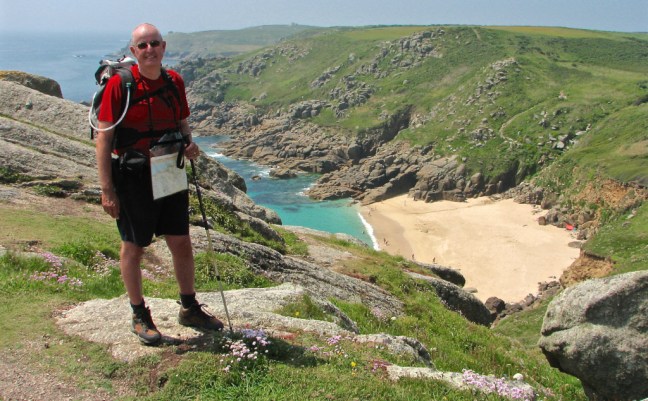 With care it is possible to descend to the beach; on a hot summers day it can get quite busy. Just beyond the beach there were the remains of a small two-roomed 8th-century chapel largely overgrown now with vegetation. One room was believed to provide accommodation and the other would have been the chapel.
 Dolphins and seals are frequently seen in this area but you need a good zoom to record them on film (this was pre-digital!). The power and grandeur of this southwest tip of England was evident as waves pushed on by running swells and tides crashed against the huge granite outcrops forming 200-foot cliffs and crags. Out to sea the Longships Lighthouse could be seen 1½ miles offshore and the Wolf Rock Lighthouse further out to sea. I was very fortunate to see the Scilly Isles as low humps on the horizon, some 28 miles south west in the Atlantic. The Scillies are Britain sunniest spot and some of it was shining on me.

 The path dropped steeply down to Sennen Cove, a former fishing village but now a retirement and resort centre. I soon reached the round house, an old circular capstan house, which offered the opportunity to view paintings and drawings of the area. After passing the lifeboat station there are a number of cafés where icecreams, Cornish pasties, fish and chips and tea could be purchased. In summer the area gets very busy. Where the road bears steeply uphill a car park leads down to beach and on a sunny day it would be tempting to have an hour or two enjoying the golden sands. For those preferring a quieter beach it is best to continue round the next headland to Gwenver beach. Both beaches are popular with surfers although the latter beach is more popular with topless sunbathers. However, as it was early spring there were no such distractions and I scurried on with a few miles of energetic and dramatic coastal walking still to do.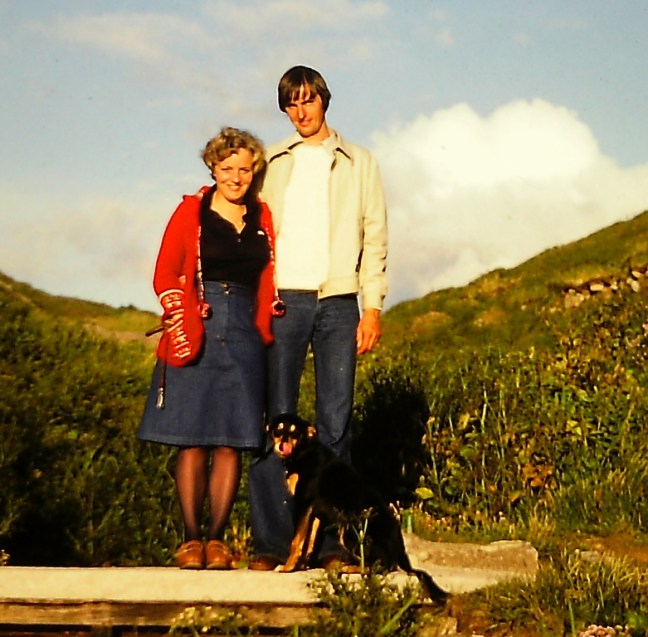












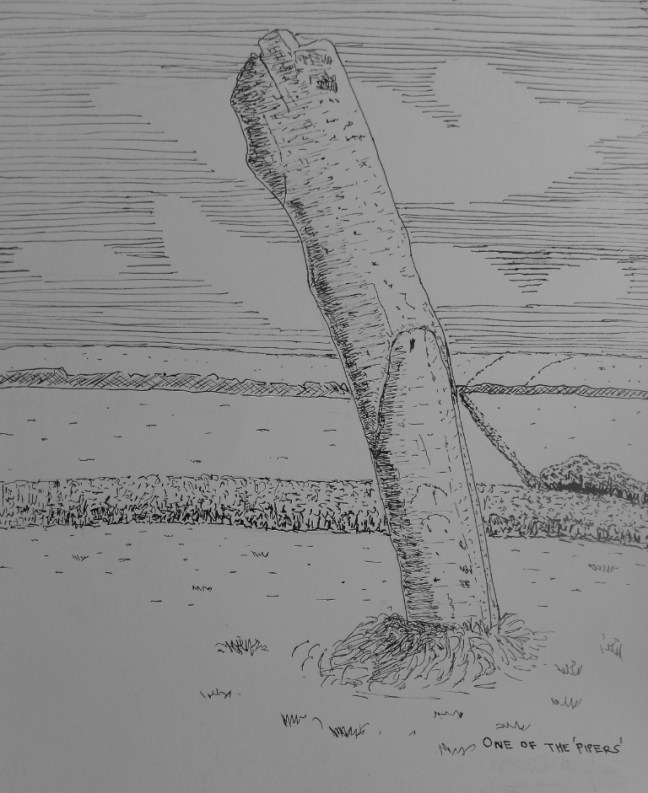

 This is a precise circle of 19 evenly spaced erect stones (as I and Cotton in 1826 only drew 18, I suspect one went missing), dating from 2400-800BC, with the tallest stones to the south-west and the shorter ones to the north. It is thought that they reflect the phases of the moon, sun and life. The circle is also known as Rosemodress, the Boleigh Circle and as Dawns Men, Cornish for ‘the stone dance’. The popular term ‘Merry Maidens’ is a folk name relating to numerous fanciful stories of young girls turned to stone for dancing on Sundays. The true purpose of the stone cicles is unclear but may have had cultural or religious significance.
 This is an excavated entrance of a megalothic chambered tomb built during the third millennium BC in the Neolothic period. The northern half of the tomb is obliterated by the road. In the 1960’s the eastern flanking stone to the entrance was found to have a random design of thirteen circular and twelve oval ‘cup marks’. This stone has been replaced by a cast replica by English Heritage.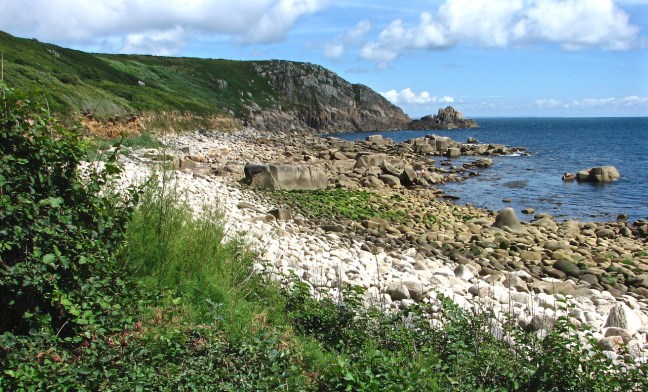




 secretwalkscom