High Spy, Maiden Moor, Cat Bells, The Dog and Gun and Hungarian Ghoulash

Post 45: 30 March 1992: Day 3 – LongthwaiteYouth Hostel to Keswick Youth Hostel – 12 miles

Emerging from the hostel in the morning, we were surprised to find that snow covered the mountain tops. However, the sun was shining, the forecast was good, so we decided to do a high-level route along High Spy, Maiden Moor and Cat Bells

The names inspired my imagination so that my enthusiasm grew as we started the climb from Rosthwaite. Gary was less enthusiastic as he had sore feet from the long previous day’s walking; well what can you expect if you walk with boots with no soles? I persuaded him we should go for the high-level route, but it was the first time we had attempted one with a pack on.

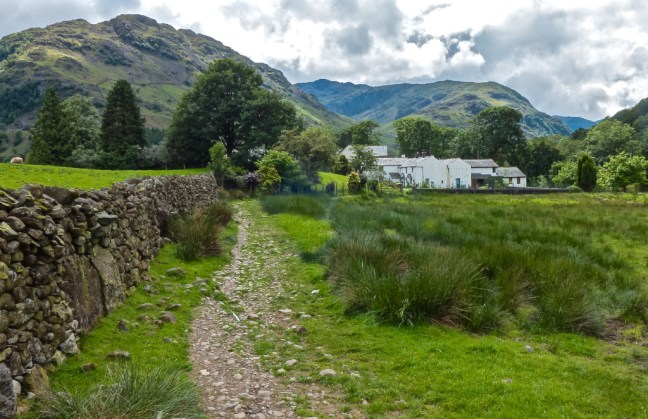
Before climbing there was some delightful lower level walking in the Rosthwaite and Castle Crag area. Photographs taken later, some with my family, show that this became and still is one of my favourite parts of the country. It deserves its title as the Golden Mile.

Lake District June 2014_2120
Looking back over from Castle Crag over the route along Borrowdale. Eagle Crag is in the middle top.
Lake District June 2014_2114_edited-1
Castle Crag
P1020589
My daughter Sophie on a navigation course. She was later to complete the Bronze Duke of Edinburgh Award.
P1020588
A helping hand for Sophie from Dad. Castle Crag in the background.
Lake District June 2014_2139_edited-1
Near Rosthwaite


Lake District June 2014_2134_edited-1
Borrowdale
Lake District June 2014_2136
Looking back to the mountains above Borrowdale
Lake District June 2014_2112_edited-1
Newlands Valley to the West of Cat Bells.

Ascending steeply we arrived at Rigghead quarries where we stopped for refreshments. This was just as well as Gary collapsed onto his back, gasping for breath. The ‘nightmare’ of hills had returned to him as he was little fitter than when walking the ‘Three-Peaks’. I was beginning to have doubts whether my decision to do the high-level route was the right one. The pack on my back felt like I was carrying a sack of coal; my thoughts went back to my childhood days when coal men, bent double, delivered sacks to my parents house. My job was to count that the correct number was delivered.

As we climbed higher and higher, the views got better and better, as the whole Helvellyn range appeared in the distance like a white-backed whale. The views back to Eagle Crag were magnificent as bright sun filtered though white clouds and reflected back off the gleaming snow. Yes, the decision to do the high-level route was the right one. Eventually we reached the top of High Spy at over 2,000 feet and stopped for yet another refreshment break; the sense of achievement was overwhelming. We were ‘New Men’, fit, refreshed, on top of the world; at least it felt like it!

Continuing along Maiden Moor, the expansive views of the Derwent Fells and Borrowdale changed gradually but delightfully and, on reaching the top of Cat Bells, we stopped in a grass hollow for our final refreshment stop of the day’s walk. There was not a finer dining place, with views of snow-capped Skiddaw, the Coledale Horseshoe, as well as the lakes of Bassenthwaite and Derwent Water. A marauding sheep kept trying to grab our sandwiches, but, when presented with a walking boot, it took the hint and left us alone.

Cat Bells is a favourite amongst the very young and elderly as it gives magnificent views without too much climbing.
P1020587
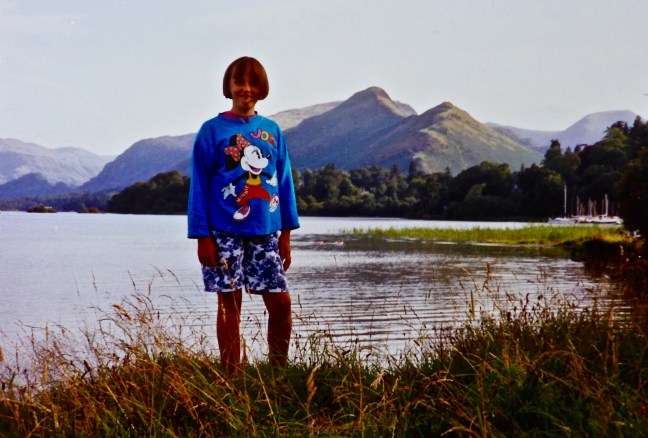
Sophie with Cat Bells in  the background. The second ‘hill’ summit.
Lake District June 2014_2108
Looking towards Keswick from Cat Bells
Lake District June 2014_2107_edited-1
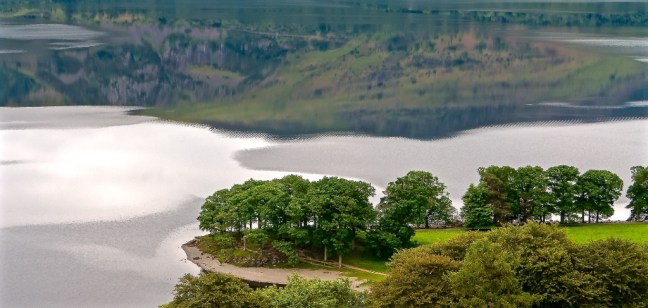
Derwentwater from near Cat Bells.
Sophie_4956_edited-1
Sophie and friend Kath having fun on/in Derwentwater in the Great Outdoors.

Arriving at Keswick at 3.30pm, the weather changed to rain, just the excuse we needed to spend the rest of the afternoon in my favourite Keswick pub, the Dog and Gun. The Hungarian Goulash is legendary and comes in two sizes. The big size is big but was needed on this occasion after all our exertions. Gary had his newspaper and I had my Guinness and, with an hour and a half to spare, this was long-distance walking at its best.

Lake District June 2014_2152
The Moot Hall, Keswick.

Keswick is noted for making pencils, which had never occurred to me when I used to chew on their ‘Cumberland’ends at school. They teach you all sorts of things at school, but never basic knowledge such as this. For walkers, the highlight of an evening in Keswick are slide shows in the Moot Hall where a ranger delights in telling you about the tourists who go to Surprise View looking towards Derwent Water then, when it is icy, slip over the 1,000 foot drop to get the surprise of their life; be warned.

In the daytime there are loads of outdoor shops where you can wander for hours, dreaming about all the expensive equipment you wish you had but can’t afford. In particular George Fisher’s shop, especially as, a few years later, it had my book, On Foot from Coast to Coast: The North of England Way, displayed in the window.

P1000677_0548_edited-1

I only found this out because my teenage children were staying at Keswick Youth Hostel at the time and happened to come across ‘Dads’ book. This meant I had achieved something as when I used to wander round Keswick in the evenings whilst on holiday with my family, I would never have dreamt that I could write a walking book which would be displayed there. How this book came about is featured later in the diaries.

A Platypus, Dungeon Ghyll, Twice Horizontal on Stake Pass, A Dieing Crocodile, A Puma, The Golden Mile.

Post 44: ‘I do suffer from headaches when I’m tense.’ said Alf.

He was looking tired and I concluded this long day was getting to him. He may have been getting uptight about the prospect of going over Stake Pass, at 1576 feet, in worsening weather conditions, with four miles still to walk and with packs. I was certainly starting to get anxious.

However, we had already made our youth hostel booking and therefore stuffed Alf with headache pills to the maximum permissable dosage. As usual I was the fifth emergency service and carried the first aid kit, with pills.

Up-date – I have since learned that de-hydration can cause headaches and indeed much worse. When, some years later, Dan was walking the West Highland Way he collapsed and bumped his head on a rock. The most likely cause was de-hydration caused by not drinking enough water. That is why a platypus water container with tube is useful so that you can take sips of water whilst walking. If you have to stop and get a bottle out of your rucksack when tired you probably won’t bother and then will de-hydrate. Dan survived and it is to be hoped the bang on the head has knocked some sense into him and he now has a platypus; but I wouldn’t bet on it.

We carried on along Great Langdale as the scenery became more and more dramatic and imposing mountains started to encircle us. We arrived at the Old Dungeon Ghyll Hotel known as the ODG, where the hiker’s bar is best described as basic, but when full of walkers and climbers is atmospheric. I finished off my flask of soup, then we proceeded along Mickleden towards Stake Pass. The valley came to an abrupt halt as Bowfell, The Band, Rossett Crag, Black Craggs and the Langdale Pikes seemed to hem us in.

P1020517
The Langdale Pikes, taken from Elterwater in 1997.
PICT0003
The Langdale Pikes
The big 50_6747_edited-2
The Langdale Pikes (Pike o’Stickle) and the jacket my wife hates as she seems to have an aversion to this green. Despite this I still have the jacket and my long suffering wife, the latter of over 42 years!!

However, a clear path led off right, ascending steeply towards Stake Pass. Alf had made a remarkable recovery and shot up the pass, I struggled up with tired muscles screaming out in protest. Meanwhile Gary who has an aversion to hills followed some way behind, stopping from time to time to look up whilst letting out cursing sounds in my direction. On reaching the top of the pass, his legs had turned to jelly so that he went headlong horizontal to within six inches of the edge of the path. Beyond it he would have rolled down non-stop 1500 feet to the bottom of Langstrath. He would have become one of the four hundred accidents to be reported in the Lake District each year.

‘You must get some new boots’, I said reminding him that his treads were well past their sell by date.’

‘Oh shut up,’ he retorted.

‘Don’t worry, it’s all down hill for the remainder of the day. At least it will be if I can find the path down to the valley.’

We wandered around in thick mist desperately trying to find the path off the crest.

‘Which way now?’ Gary said impatiently, putting more pressure on me. Tempers start to flair when tiredness creeps in. Decisions can be rushed and mistakes made.

‘If I knew I would be hell for leather down it,’ I said trying to keep calm. Eventually a clear path emerged out of the mist. As we descended I breathed a sigh of relief for the mist cleared to reveal the whole of Langstrath before us.

The walk would have been all downhill if the rain hadn’t been so bad that the streams running down the valley sides were now raging torrents. This meant that the only way to cross them was to ascend the hillside to find an easier crossing. On seeing a fallen tree across one such stream, Gary decided to take a short cut across it. Getting half-way across on all fours horizontal he suddenly realised that with a full-pack his centre of gravity was about two feet higher than normal, so that at anytime he would suddenly turn completely upside down to end up on his back in the water like a dieing crocodile. Instead, like a puma, he stealthily moved backwards until he got back on land to breath a sigh of relief. I was mightily disappointed as I had my camera poised to catch the almighty splash.

On reaching Longthwaite Youth Hostel at 5.30pm, the sun came out for the first time; it was sign that this was Alf’s last day. He had to leave us in the morning to return to work. (Update – he was starting to get a reputation for never finishing a long-distance walk and this has continued ever since).

There are fewer, if any, more beautiful places on earth than Borrowdale in sunshine. The days labours were well rewarded as we were now in the ‘Golden Mile’ of the Lake District. We were also at a point where Wainwright’s Coast to Coast walk crossed our route and memories came flooding back.

The Golden Mile of Borrowdale taken from Castle Crag.

The World Speed Record on Water, Passing your MOT, I Have a Headache.

Post 43: The route took us through fields and farmyards, then, at Higher Lath Farm, we went slightly wrong where the fold of my map was over some buildings, which I should have been looking for. This was the opportunity for Alf to give me some stick, which seems to be a favourite pastime of my walking companions. In their minds 200 yards off-route becomes 20 miles and I seem to get the full force of their frustration. However, it certainly leads to increased concentration in finding the correct route.

We arrived at Beacon Tarn, which provided an excuse for a refreshment stop. A family consisting of Grandad, Grandma, Mom, toddler son, and Dad were progressing towards us, up to their ankles in mud. Dad was the only one carrying a pack and it was huge. They stopped at the tarn and I couldn’t help but contemplate the difficulties when walking with toddlers. I was pleased that my children had passed this stage so that I could now stroll out independently and fast. However, I never regretted the short walks I had experienced in the past with my own children, but it is good to move onto another phase in life.

Our next stop was on the edge of Coniston Water, next to a dead sheep, which we only noticed when I started to take some photographs. The views along Coniston were impressive and it was possible to imagine (Sir) Malcolm Campbell setting the world record of 141.74 mph in his powerboat Bluebird, some 138 mph faster than we were walking. Between 1956-59 Donald Campbell broke the record five times (the last time reaching 276.33 mph). On 4 January 1967, however, he was killed on the lake when trying to raise the world record to 300 mph. His body was never recovered.

Despite our low speeds and the relatively flat terrain, Gary managed to slip over at least twice. On inspection, the soles of his boots had no tread on them and it was clear he would fail an MOT. I had warned him on numerous occasions of the dangers of not having decent treads on his boots but, as ever, he took no notice. He tried his hardest to break a leg at 3 mph, heaven knows what he would be like in a boat at 300 mph.

After some pleasant woodland walking, along the waters edge, we arrived at Coniston Hall, a late 16th-century manor house, which has several chimneys that are built so large the owner must have had a fixation on Father Christmas.

29 March 1992: Day 2 – Coniston Youth Hostel to LongthwaiteYouth Hostel – 19 miles       

On paper this was always going to be a tough day and one option, not accepted due to Gary’s tight schedule, would have been to split the day at Elterwater Youth Hostel.

We left Coniston Youth Hostel at 9.00am, just as the bright sunny morning turned to rain. For some reason, Gary and Alf had not brought their gaiters, which was a little surprising as they are designed for the type of muddy and wet terrain we were due to walk through that day. The climb to Tarn Hows was harder than anticipated, possibly because the rain had made everywhere slippy. In thick mist and heavy rain this tourist honeypot did not look quite as attractive as in the postcards and calendars. This is one of the great honeypots of British tourism, with an estimated 750,000 visitors a year.

Tarn Hows
Tarn Hows

This most perfect of Lakeland landscapes is man-made. Until the last century there was a collection of small pools here known as Monk Coniston tarns or the Tarns, and it wasn’t until a small dam was built across the outflow stream, Tom Gill, that this famous spectacle of water was created. The Ordnance Survey still call it ‘The Tarns’ on their maps.

Tarn Hows
Tarn Hows

Some time after leaving the tarns, we stopped for refreshments adjacent to the Coniston-Ambleside road, with the choice of sitting on a log in the pouring rain or on grass in the shelter of a tree. I was cheered up shortly afterwards when some orienteers came running through the woods, slipping about on the mud, soaked in fairly flimsy tee-shirts; I felt quite sane doing what I was doing compared to their activity. Defined as a competitive sport of finding one’s way across rough country with a map and compass, orienteering originates from Scandinavia where it was introduced in 1918 as a sport for young people. Like all crazy ideas it was exported to Britain such that veterans in their 60s run around looking for bits of paper displaying a clue to the next destination. I have enough trouble trying to get to real destinations without looking for bits of paper.

Arriving at Elterwater, I began to wish I had split the day, especially when I saw the Britannia pub was quite close to the hostel.  It was here a few years later that we met sexy Sarah at the hostel. However, on this occasion there was no Sarah; instead Alf who started to complain.

‘I’ve got a headache.’

‘A headache? Out here in all this fresh air?’ This caused me some concern as, at only 100 feet, I decided it couldn’t be altitude sickness. Fresh air is supposed to clear headaches and I had never heard of anyone having a headache when out walking, unless in the ‘death zone’ near the top of Everest.

The start of a new walk – The Cumbria Way

Post 42: March 1992 -The Cumbria Way – maturity, aged 40

After Wainwright’s Coast to Coast walk, I was keen to experience some more of the wonderful Lakeland scenery and the Cumbria Way seemed to fit the bill perfectly, starting as it does at Ulverston in Southern Lakeland and heading north through central mountainous Lakeland to finish at Carlisle. At some 70 miles, the walk could be done in five days, therefore not impinging too much on my busy work and home life. The walk is, for the most part, through lowland valleys and therefore would be less susceptible to bad weather. If the weather was good there would be opportunities to walk some high-level routes.

P1030833_6939_edited-1

The National Parks and Access to the Countryside Act of 1949 provided for the designation and subsequent completion of long-distance routes along which ‘the public should be enabled to make extensive journeys on foot or on horseback.’ In 1998, the Royal Opera House received the same annual subsidy as all the national parks of England and Wales put together. The opera house serves fewer than five hundred thousand people and received sixteen million pounds, as did the national parks, which were visited by seventy-five million people.

Individuals or other organisations other than the national parks have created long distance walks. The Cumbria Way was an ‘unofficial’ route created by the efforts of members of the Ramblers Association using existing rights of way.

To say members of the Ramblers Association were somewhat obsessed with rights of way is an understatement. Their magazine ‘Rambling Today’ had numerous details of cases against farmers, landowners and local authorities as well as enough legal information to satisfy the most ardent barrister or solicitor. Every other sentence was dominated by the word ‘access’, to the extent that you couldn’t help wonder if some of the members ever got time to go out just to enjoy a walk.(Update – this is no longer the case and their magazine is much more informative on general walking matters – maybe they have now achieved many of their access aims).  However, what was the biggest single participation event in the Ramblers calendar? Well, according to their magazine it was the raffle. In 1996 members bought, or sold, 126,850 tickets, contributing £53,354 to the Step Alive Fund. Now if that is not evidence that the Ramblers Association was really a front for Gamblers Anonymous then I don’t know what is! (I am only joking – please don’t get the solicitor’s onto me!) One of their best legacies is the Cumbria Way.

On a more serious note, they have lobbied very effectively in maintaining many rights of way which otherwise would have disappeared and the proposed legislation on freedom to roam in the late 1990s is very much due to the good work of the Ramblers Association. They have done a lot for Access including the creation of National Parks, creation of long-distance walks including the Pennine Way, open access, free walking in Scotland, the opening up of the England coast path, ensuring the future of woodland walking. So they are a charity well worth supporting. They also provide a wide variety of walking holidays.

They are also great for people who are more sociable than me and who like walking in bigger groups!

27 March 1992

I left York with Alf and Gary on the 1.37pm train. My pack weighed twenty-eight pounds as per Coast to Coast, although my own weight was twelve and a half stones, half a stone heavier than the previous year. One of the enduring features of middle-age is that one’s weight tends to steadily go up rather than down. The best advice is to increase the amount of exercise, but with family and work commitments this sometimes is just not possible. We changed trains at Leeds and Preston, where Gary nearly missed the train as he was learning some lines for his forthcoming appearance as Joseph in the York Mystery plays.

The start of the walk, Ulverston, is somewhat unusual as it is the home of the Laurel and Hardy museum, due to Stan being born in the town. The appearance of Gary and myself is not dissimilar to these famous comics, me being the taller thinner one and Gary being the shorter rounded one.

The evening was spent playing darts in one of the local pubs; Ulverston is hardly a Mecca for entertainment.

28 March 1992: Day 1 – Ulverston to Coniston Youth Hostel – 16 miles

The start of the Cumbria way is a bit disappointing, an uninspiring sign at the top of an open area called The Gill, north of the market place. I would have thought that Bardsea near to Ulverston Sands would have given a more definitive start, with views across Morecambe Bay. I was glad to be getting away from the trappings of civilisation for a few days, although Gary and Alf couldn’t resist reading newspapers before we left the bed and breakfast accommodation. After devouring a hearty breakfast, we left Ulverston at 9.00am. With no pubs or cafés on todays walk we stocked up with plenty of food and drink. The weather was warm and clammy so that I began to wonder why I had brought my cold weather gear; the reason became evident later on during the walk.

6D (old pence) for a Hearse, Becoming a Man, a Pint at Robin Hood’s Bay, the End

Post 41: 10 April 1991: Day 13 – Glaisdale to Robin Hood’s Bay – 19 miles

Woke up to sunshine piercing through the curtains. This was it, the last day of this epic journey having survived getting lost in the Lake District, overcome appalling weather and losing the company of Archie. However, I had met many new people and made a number of new friends, not least Wendy and Clint who would be walking with me on this last day. I felt six feet tall; actually I am six feet two and a half inches, but maybe a couple of inches had worn away after 171 miles of walking. One thing for sure, my feet were much larger and I was now down to wearing one pair of socks rather than two pairs as in St Bees. Top tip; always have boots that allow for foot expansion on these walks so that you start with two pairs of socks, a thin wickable inner sock and a thicker wool based outer sock. As the feet get bigger you can take the inner socks off. When you buy a pair of boots you should be able to get a finger down the back when the foot is pressed forward. My walking boots are normally a size larger than my normal shoes. My feet expanded about half a size on this walk.

By now, I looked like a weather-beaten beetroot, resulting from the effects of wind, sun and rain. Due to the need to keep my pack weight down, I only allowed myself a tiny tube of sunblock and a travel sized bottle of aftershave. Only Wendy, like any female, bothered to carry make up and smellies; it seems a woman must always be at her best, even on Coast to Coast. I decided not to do any more clothes washing as the washing machine at home was getting nearer and hand washing lost its attraction.

We had a huge heart attack breakfast, picked up a substantial packed lunch, then had a quick photo call in bright sunshine outside the pub; we were in good spirits and were excited to be starting on the last day.

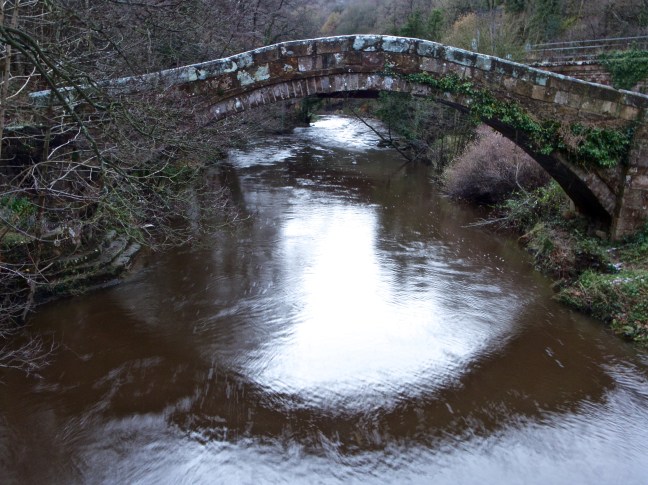
We soon arrived at the early 17th-century Beggar’s Bridge, feeling not unlike beggars in our dusty, dirty and well-worn clothing.  The bridge was built by Thomas Ferris in 1619. Ferris was a poor man who hoped to wed the daughter of a wealthy local squire. In order to win her hand, he planned to set sail from Whitby to make his fortune. On the night that he left, the Esk was swollen with rainfall and he was unable to make a last visit to his intended. He eventually returned from his travels a rich man and, after marrying the squire’s daughter, built Beggar’s Bridge so that no other lovers would be separated as they were. Isn’t that romantic?

P1060764
Beggars Bridge.

We had a pleasant climb parallel with the River Esk through East Arncliffe Wood then, just after Egton Bridge, we arrived at an old toll booth sign:

P1060779

The only category we felt we could fit into was the hearse, as we felt half dead through tiredness.

We continued along a track to Grosmont, which is a main station on the North York Moors Railway and where many of the trains are ‘steamed up’ in the morning. The railway from Pickering to Whitby was created by George Stephenson and after being threatened by closure was kept open by the North York Moors Railway Society.

Grosmont
Grosmont
The Whitby Enterprise
Sir Nigel Gresley
GrosmontApril08 059
The Whitby Enterprise
The Flying Scotsman - iconic
The Flying Scotsman – iconic

After a steep climb out of Grosmont and the crossing of Sleights Moor, we arrived at the pretty valley of Littlebeck, which boasts a hermitage hewn out of rock, dated 1790 and initialled GC.

Wainright's Coast to Coast 1991

With the prospect of a return to work looming, I was inclined to take up residence and become a hermit. However, it is difficult to give up modern comforts and instead continued along Littlebeck to the lovely waterfall of Falling Foss, where we stopped in bright sunshine for our final packed lunch of the walk. I have a very good friend who lost her father at a much too young an age and he was laid to rest in this area, a beautiful, tranquil and peaceful resting place.

After a further seven miles, much of it over moorland, the sighting of the North Sea is a delight, but there are still three miles until the end of the walk at Robin Hood’s Bay.

Robin Hood's Bay. Wainwright's route finishes along the cliffs on the far side - a delightful 3 miles of walking and a fine and fitting end to a magic walk.
Robin Hood’s Bay. Wainwright’s route finishes along the cliffs on the far side – a delightful 3 miles of walking and a fine and fitting end to a magic walk.

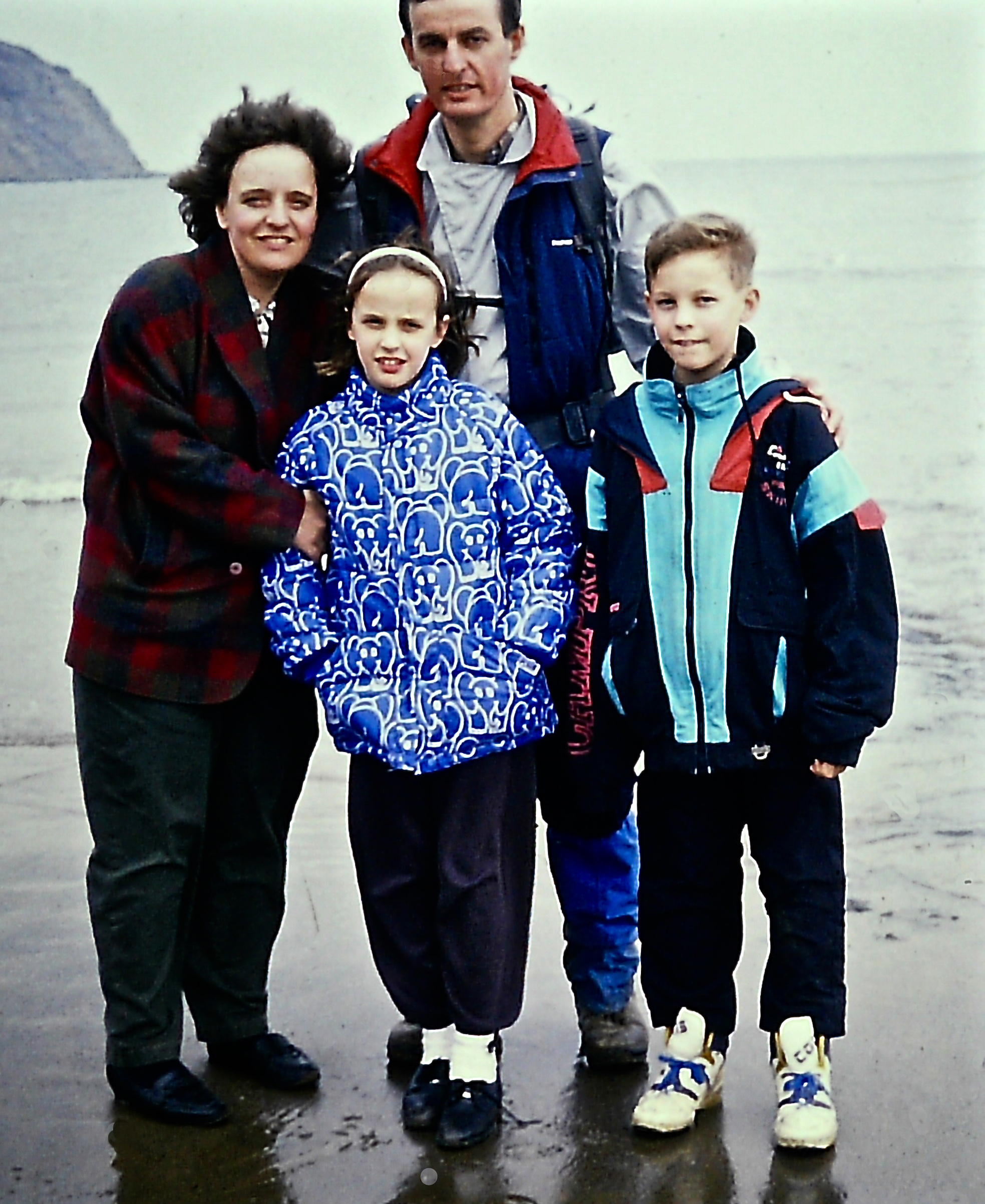
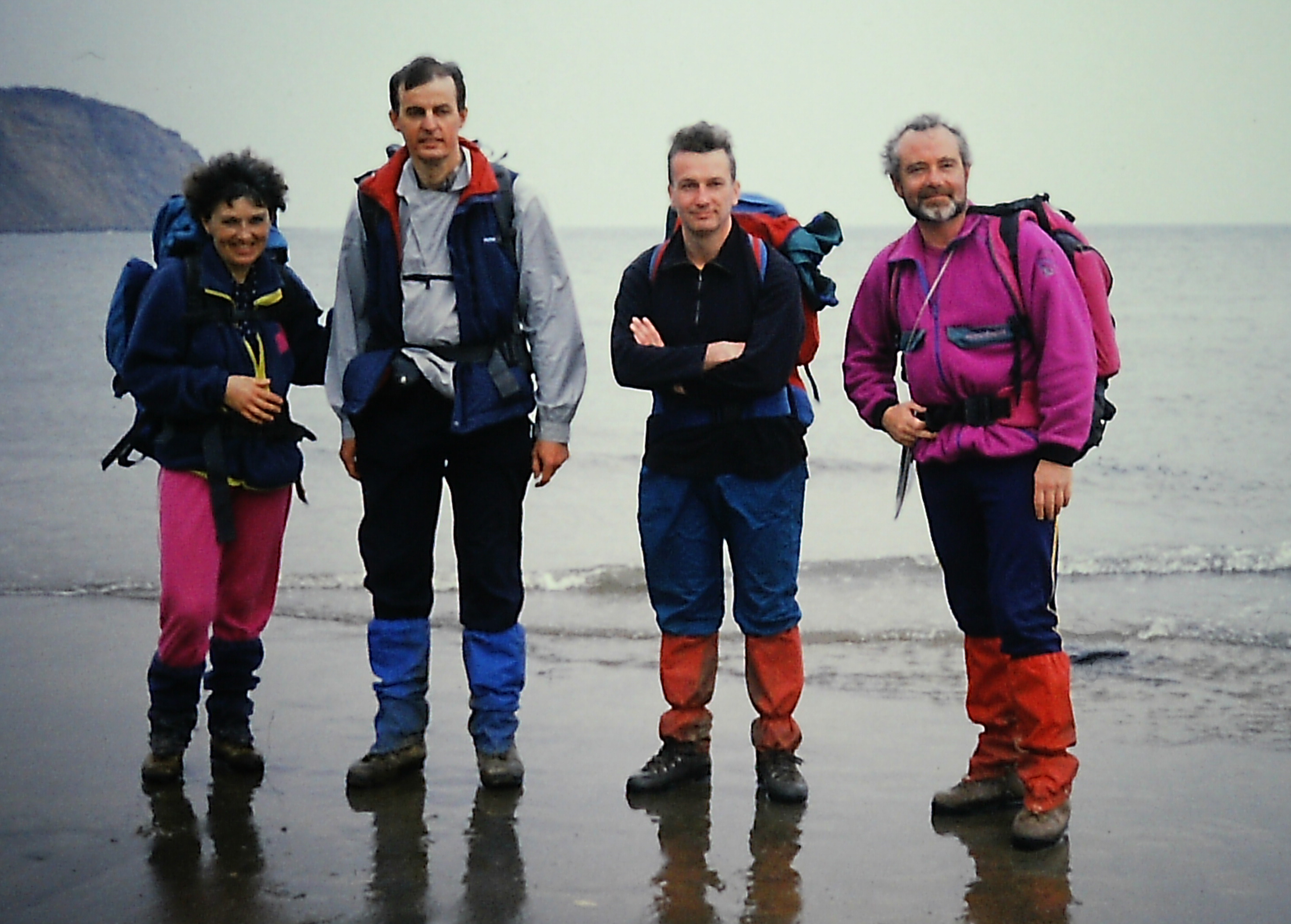
We arrived at 5.00pm and met the Black Country Stompers. On the windy beach was my wife Celia, daughter Sophie and son Alastair.

The big 50_6696_edited-1

The traditional dip in the North Sea and a photo call was immediately followed by a celebratory pint in the Bay Hotel.

The big 50_6701_edited-1

PICT0003
A well earned and much needed Guinness

I was now a man according to Wainwright and no longer a boy!

P1020516
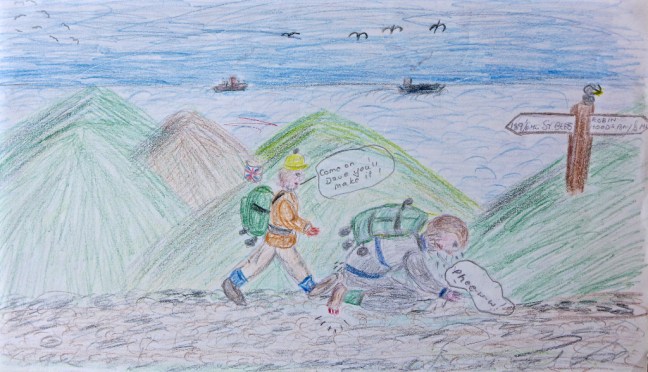
This is me on my knees as portrayed by my 10 year old son at the end of Coast to Coast.

P1020515

September 1991

I was walking in Littlebeck with my wife and family and we met a father and teenage son walking Coast to Coast for the third year in succession. I had thoroughly enjoyed Coast to Coast and thought I would like to do it again sometime in the future, but not three years in succession; that was crazy.

One evening, when I was mulling over Wainwright’s Coast to Coast Pictorial Guide, I read his Personal Notes in Conclusion at the end of the book. I had read them before, of course, but on this occasion my eyes stopped in the middle of page xiv: ‘… but I would feel I had succeeded better in arousing interest for the planning of private long-distance walks if the book induced some readers to follow instead their own star and find their own rainbow’s end.’

Wainwright succeeded in my case and there and then I decided to take up his challenge to plan my own alternative coast to coast walk, which I hoped would be as equally attractive as Wainwright’s and which would allow a relatively solitary walk across England, taking in three of the country’s finest National Parks – the Lake District, the Yorkshire Dales and the North York Moors. However, I was unable to walk my coast to coast route for another eighteen months and therefore decided to walk the Cumbria Way the following year to ‘fill in’ for 1992.

The Highest Point of the North York Moors, a Lion, Fat Betty and Explosives.

Post 40: 9 April 1991: Day 12 – Great Broughton to Glaisdale – 19 miles (from Clay Bank Top) 

In the morning we paid our pound to get a lift back to Hasty Bank and the Coast to Coast route. I had arranged to meet Clint and Wendy at the car park, but had in fact waited at a different end of the car park. After ten minutes we stumbled into each other. It was good to have some companions to walk with now that Archie had returned home.

We ascended to Urra Moor and the highest point of the North York Moors at Botton Head at 1491 feet.

White Rose Walk_3452_edited-1
Urra Moor. Cold Moor to the far left in the distance and the Wainstones after the dip.

Our spirits were high on this penultimate day, the weather was good with clear and bright skies. Arriving at Bloworth Crossing on the dismantled Rosedale Ironstone Railway, we decided to pretend we were trains, such was our delight at being on flat easy walking for 6 miles. We even started singing train songs, such is the effect a Coast to Coast walk can have. At this point, I decided to do what the Americans call ‘power striding’ where you stride out at great speed, in my case pretending to be an Inter-City 125. My ‘youthful energy’ was definitely returning as I sped along the dismantled railway line around the head of Farndale! Perhaps there was another motive? I soon arrived at my goal the Lion Blakey Inn, dating from 1553 and conveniently situated on the top of the moors at 1,325 feet.
P1060675
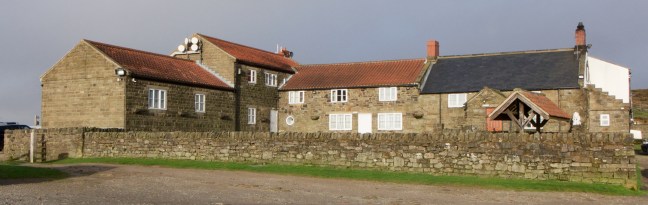
The Lion Blakey Inn

You have to leave your muddy boots outside, but unfortunately it has been known for boots to be stolen. I found it difficult to relax knowing that my Coast to Coast walk could finish if someone decided to take my boots.

Suddenly a Saga coach trip arrived full of elderly people; they had great difficulty walking the few yards from the coach to the pub. I really did feel super fit and young again! In an outdoors magazine survey in December 1997, the Lion Inn was included in the nationwide top ten pubs. It has a fine selection of beers including Theakston’s Old Peculiar and, if hungry, there is even an Old Peculiar casserole. There is also a welcoming fire, which makes leaving the pub one of the most difficult challenges on Coast to Coast.
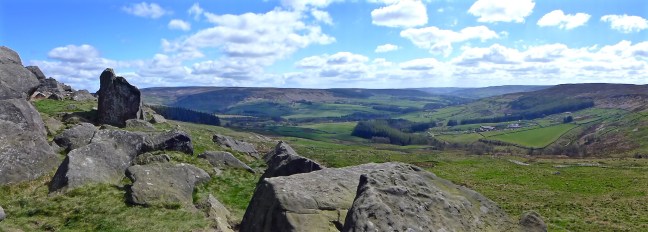
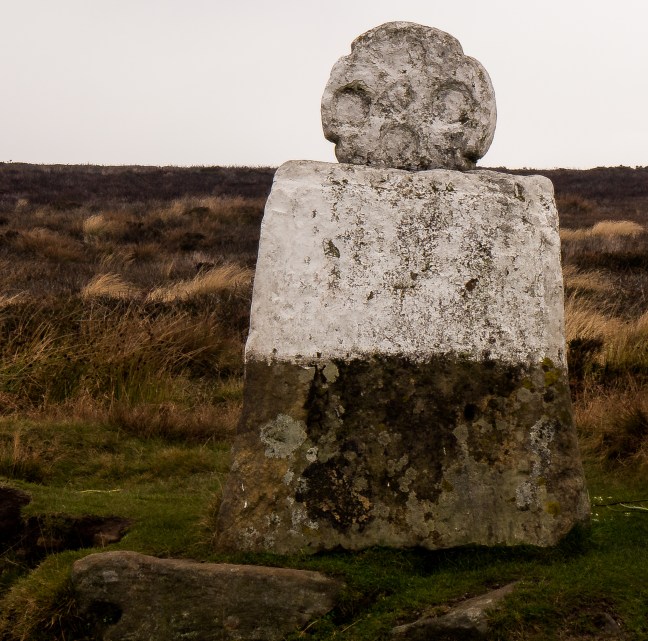
Deciding we wanted to finish the walk, we left and soon ‘met’ Fat Betty. No, this is not a lady who comforts coast to coasters, but is in fact one of a number of crosses to be found on the North York Moors; many of these crosses were thought to have acted as markers or guides to monks, travellers and traders crossing the moors. There are often coins on top of the crosses, which are left for those who have run out of money.

P1000273_edited-1
Fat Betty

Wendy had her radio and headphones on as we walked briskly over Glaisdale Rigg. We did not stop again until we reached Glaisdale.

P1060717
Glaisdale and bottom right the powder house used for the local ironstone mining, which took place between 1862 and 1876. It lost its roof in about 2009.

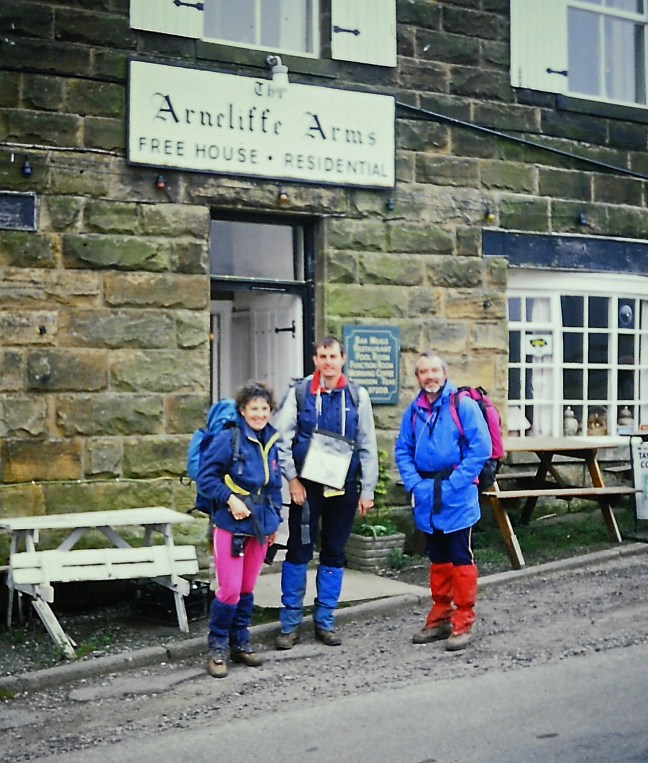
The Arncliffe Arms at Glaisdale was our last overnight accommodation of the whole walk.

The big 50_6697_edited-1
The Arncliffe Arms

It was definitely a ‘male domain’, as a group of men listened to Country and Western tunes of a bygone era. There was also Neil Young singing ‘Heart of Gold’ and other seventies music, which I had listened to some twenty years earlier when I was an undergraduate student; like the North York Moors, the juke box was stuck in a time warp. The landlord of the pub said it was a pity it wasn’t karaoke night; I wasn’t so sure…………….he hadn’t heard me sing.

Who is Brian? Advice on Taking your Trousers down on Cold Moor and The Tallest Man in the World. Don’t cheat.

Post 39: Please note that as this is one of the best walking sections of the North York Moors, most of the photographs were taken at a later date as on Coast to Coast there was not the time or energy it needs to do justice to its beauty.

Some years later, I was walking the next section of Coast to Coast with Penelope, who had just asked numerous questions about the mine workings in the area. We left the Coast to Coast route to return to the car by a circular route. Through the mist and snow we reached a small pond named Brian’s Pond on the Ordnance Survey map.

‘Why is this pond called Brian’s Pond?’ she enquired.

‘I don’t know, perhaps Brian found it?’ I replied clutching at straws.

‘Well who was Brian?’

‘Perhaps he was a farmer who lived hereabouts?’

‘Seems unlikely to me,’ she said unconvinced.

‘Okay, I’ll find out when I get back home,’ I promised. To this day I have not been able to find out why the pond is so named. If anyone knows how the name came about please let me know; a promise to a lady should never be broken.

Leaving Brian’s Pond with Penelope, we reached Scugdale Hall where Harry Cooper, reputed to be the tallest man in the world when he was exhibited in Barnum’s colossal show in America, spent the early years of his life as a farm servant. In five months he grew thirteen inches whilst confined to bed and at the age of twenty-three measured eight feet six inches in height and weighed twenty stones. In 1198 he died in Calgary, Canada, at the age of forty-one, weighing twenty-one stones. It’s a small world as Penelope heralds from Canada.

Back in my ‘time machine’ to 1991 on Coast to Coast we continued to Cringle End at 1472 feet were there is a view indicator, this being a memorial to Alex Falconer (1884-1968) who under the pseudonym of ‘Rambler’ was a champion of walkers’ interests.

Lyke Wake Walk_0608

Arriving on Cold Moor Wendy was complaining about her leg muscles hurting and so I suggested she put some Radian B on them.

Lyke Wake Walk_0620_edited-1
The Wainstones taken from Cold Moor

‘I can’t it’s my thigh,’ she said ‘I would have to take my trousers down.’

‘Don’t be modest, do you want to finish this walk or not?’ I replied. ‘Nobody will notice up here and Clint and myself will walk on a little way.’

‘Okay,’ she said taking my Radian B and turning off into the heather. Wendy has the honour of being the only recorded person to take her trousers down on Cold Moor. In addition, it was her birthday!

I must issue a health warning at this point and say that taking your trousers down on Cold Moor is not recommended as it catches winds from the north, east, south and west; if male you are likely to get frost bite or sun burnt, depending on the time of year, on an essential part of your body.

Now they say you don’t know what you don’t know.

In 1991  I was not really aware of the following hazards that Wendy could have encountered by taking her trousers down. I have only become aware of some of these hazards and encountered them after many years of walking on the Moors. In no way should any of them put you off walking on the Moors.

There are adders on the North York Moors:

Lyke Wake Walk_1168_edited-1
This adder has just has his dinner me thinks
Lyke Wake Walk_1173_edited-1
This adder is on a diet
The big 50_6745
An adder in the grass this time
The big 50_6746
I stepped over this one without noticing it!

In 30 years I have had 3 close encounters with adders so that’s pretty low odds. 1 every 10 years. I have each time come close to stepping on them but still had time to photograph them. So keep your eyes open as if you step on one it is likely to bite. The venom is rarely fatal. Keep calm, clean and dress the wound. A bandage or tourniquet above the wound is useful. Then get to hospital as soon as possible.

There are also ‘scary’ harmless creepy crawlies:

Lyke Wake Walk_1939
Creepy crawlies that come out of dark shadows.

White Rose Walk_3442_edited-1

There are also ticks that can bite. If left untreated the bite becomes infected and leads occasionally to an illness called Lyme Disease. This can be very nasty and result in inability to move both sides of the face, joint pains, severe headaches with neck stiffness or heart palpitations. In 1990 there were only 19 cases so Wendy was pretty safe but in 2010 there was an increase to 953 cases. The best advice is to wear clothing, especially on the legs, that covers and protects the skin.

Lyke Wake Walk_0618_edited-1
From the Cleveland Escarpment, Roseberry Topping, the ‘Yorkshire Matterhorn’, can just be seen in the distance and Middlesborough to the far left.


Lyke Wake Walk_0644_edited-1.
At the Wainstones
Lyke Wake Walk_0639_edited-1
Looking back to Cold Moor
White Rose Walk_3451_edited-1
The Wainstones
Lyke Wake Walk_0630_edited-1
I believe this is Cleveland ironstone which is hereabouts

The Wainstones are the sharp edge of the Cleveland Hills, facing north over the Tees Valley. Erosion has exposed the thick slab of Middle Jurassic sandstone that forms the cap of the hills. As rain and wind wears down the soft rock underneath, huge square boulders break off. Not good if you are on the boulder at the time!

As we approached the Wainstones we noticed two coasters to coasters take the path off left towards Bank Lane and Great Broughton. Now this would be acceptable as long as they did not take the customary taxi ride back in the morning to Hasty Bank car park. If they did then they would be disqualified from Coast to Coast as they would not have walked completely from one side of England to the other. Next morning we ‘tested’ them out.

‘The two miles of road walking from Hasty Bank to Great Broughton were hard on the feet weren’t they?’ I said.

‘Actually we cut the corner off by going through the woods.’ They looked suitably sheepish and guilty. The long-distance walkers ‘Ethics ’ committee does not approve of such goings on. It’s cheating and leads to disqualification from having completed the whole walk.

Today had been a splendid day’s walking with marvellous views, even though exposed to constant winds. For varied scenery Coast to Coast takes some beating.

Lyke Wake Walk_0622
Looking from the Wainstones towards Bilsdale
Lyke Wake Walk_0657_edited-1
Looking back across the Tees valley

An Encounter with a Ruthless Killer and a Lady in the Gents.

Post 38: 8 April 1991: Day 11 – Ingleby Cross to Great Broughton – 16 miles (to Clay Bank Top) 

Awoke with a stiff neck! Applied Radian B, which seemed to do the trick but made me very unpopular at breakfast.

After stocking up with various goodies at the Post Office we left the Blue Bell Inn at 9.15am, with a long day ahead. The Post Office had never done so much business at 9.00am on a Monday morning.

We soon passed Mount Grace Priory dating from 1398, this being the best preserved of nine Carthusian monasteries that were built in England. Each of the twenty-four monks had his own small, two-storey cell and rear walled garden. Serving hatches adjacent to the cell doors permitted meals to be passed anonymously to the occupants. The BBC2 television programme, A Coast to Coast Walk, shown in the late 1980’s, certainly helped to put this fine historical site on the map. The power of television should not be underestimated as, after Sir David Attenborough’s programme, Stoats in the Priory, was screened in April 1996, attendance figures at the priory increased from 35,000 per annum in 1996 to 42,500 in 1997, then, after a repeat showing of the programme, a further increase to 45,000 was predicted in 1998. This despite the fact that stoats have daggers for teeth, are ruthless killers, perform a demonstrative, frenzied dance to hypnotise their prey, and give off a foul odour to deter those that threaten them. There have been no reported attacks on Coast to Coast walkers but they frequently kill rabbits eight times their weight and terrify song-birds and moorhens.

Leaving the dangers of the stoat populated priory, the picturesque village of Osmotherley was reached, once noted for having one of the most ferocious youth hostel wardens ever, who reputably was ex-SAS. In more recent times the village has become infamous for its toilets, men coming out of them laughing uncontrollably. At first you think there must be something naughty going on and when one morning I walked in to find a female, my suspicions were confirmed.

‘Good morning,’ I said.

‘Good morning luv,’ she replied.

My mind raced as I wondered what to do next. ‘Is it alright if I go in there?’ I said, pointing at a cubicle, where at least I thought I would get some privacy.

‘That’s fine luv,’ I’ve nearly finished. Finished what I thought? Then I saw her wipe the floor with her mop. That was it, she was the cleaner. I sat down on the toilet pan and sighed with relief. As I sat there it suddenly dawned on me why everyone leaves laughing; the walls are covered by jokes on newspaper cuttings, put there by the cleaner. I flushed the toilet, then left with a wide grin on my face. Such are the joys of the countryside.

Despite Wendy having a muscle strain in her leg, probably caused by trying to get away too quickly from lurking stoats, excitement grew as we started to climb onto the North York Moors.

The Unexpected

Post 37: Sometimes on a long-distance walk one comes across unexpected gems of information.
Walking on the Wilberforce Way today I came across a memorial in St Mary’s Church in the tiny village of Etton. Turns out that the memorial was to John Lothropp. He was baptised in the church in 1584. He was ordained in the Church of England but grew increasingly unhappy with the established church. So he left the Church of England to to become minister of the First Independent Church of London. He was a strong proponent of the idea of of the separation of the Church and State, keeping government out of the church and the church out of government. This idea was heretical in England during the time but eventually became the main the mainstream view of people in the USA. Due to imprisonment by the establishment authorities he was forced to move to New England arriving in Boston on the Griffin on 18 September 1634. After a difficult five years his group moved to Barnstaple, Cape Cod. From his 12 children there descended many famous people, including 6 Presidents of the United States:
George H . W Bush
George W. Bush
Millard Fillmore
James A. Garfield
Ulysses S. Grant
Franklin D. Roosevelt
In Etton I also came across a plaque to Thomas Carling.


P1020035Turns out the history of Carling Brewery dates back to 1818, when Thomas Carling a farmer from Etton settled in eastern Canada, at what is known as the city of London, Ontario. In 1840 Carling began a small brewing operation in London and as they say the rest is history. I once visited my much missed good friend Penny Bolton-Galbraith who lived at Poplar Hill, Ontario near London. My daughter Sophie Walker is employed by Molsen-Coors who own Carling!
Hard to believe this all started in a tiny little village in Yorkshire! What a small world we now live in and it never fails to surprise me as to what I come across on walks.

An encounter with a 169 year old. The end of C to C for Archie.

Post 36: 7 April 1991: Day 10 – Bolton-on-Swale to Ingleby Cross – 15 miles

There is a memorial in St Mary’s churchyard, Bolton-on-Swale, to Harry Jenkins who was born in the year 1500 and died in 1670, at the grand old age of one hundred and sixty-nine. That morning Archie’s feet and legs were in such bad shape, he was feeling about one hundred and seventy. One leg was badly swollen. Hardly a ‘New Man’.

‘It’ll be a piece of cake today, only fifteen miles and all flat across the Vale of Mowbray,’ I said, trying to improve his morale.

However, one of the strange things about walking on lanes is that it seems more tiring than on undulating moors and mountains. The feet are put down in the same repetitive manner leading to a sort of repetitive strain, the equivalent of which, typists and computer operators experience in the hands.

We arrived at the wonderfully named village of Danby Wiske, hoping to obtain a drink at the pub, but, unfortunately, it was closed. We somehow managed to lose Clint when he stopped at a kiosk to phone home. Archie was now in trainers, but was still making slow progress. Trainers are recommended for arduous road walking as, compared to boots, the increased cushioning eases the foot pounding. We couldn’t afford to wait any longer for Clint and eventually left Wendy waiting for him in the village, listening to Radio 4. We felt a bit guilty at leaving a female on her own, but sometimes such decisions are necessary and we were sure Clint would soon join her.

Shortly before Ingleby Arncliffe, we encountered the last major obstacle of he day, the A19 dual carriageway. After 139 miles of walking, cars don’t seem to just go fast, they scream past as though attempting to break the world land speed record. Even small lorries sound and look like juggernauts. It would be easier to cross the East Rongbuk Glacier leading to Everest than cross this road. No wonder so many hedgehogs and other animals end up splattered on the tarmac. After about ten minutes, when nothing could be seen or heard, we scurried across with our packs jumping up and down on our backs, delighted to get safely to the other side.

The big 50_6758
Nearing the end of Coast to Coast for Archie.

At Ingleby Cross, it was evident that Archie was in great pain and could not carry on to our booked accommodation at the Osmotherly Youth Hostel. Instead we managed to book a night at the Blue Bell Inn, where, joined by Clint and Wendy, we had a ‘last’ supper for him. He decided that Coast to Coast had come to an end and he would catch a bus to Northallerton, then train home to London. He had walked 140 miles with only another 60 to go, ten days completed, only three left. It was a sad way to end a walk. On his return to London he saw a doctor who, to our surprise, said that he had been bitten by an insect, which had caused the swelling in his leg. The one thing I hadn’t brought with me was insect bite cream as I never imagined insects would be around at Easter. How wrong can you be? Another lesson learned.

Archie couldn’t be regarded as being a ‘New Man’ at this point, more like a ‘Broken Man’, but it was not so long after the walk that he took the plunge and got married. Clearly the hardships of Coast to Coast had made him realise that a pair of slippers by the fireside might be a better option. The long-distance walkers’ ‘Ethics ’ committee allows for up to five years off from long-distance walks in order to get married and/or have children. However, it was not long before he returned to long-distance walking; once tried it is difficult to give it up.