Ambleside, Bridge House, Squirrel Nupkin, Shooting from the Hip, Paradox Virus and Stunning Views.

Post 56: Further pleasant walking through woodland, along country lanes, then through woodland again, brought us to Colwith Force, where we stopped for lunch, which included sandwiches, yoghurt, crisps, cake and died apricots. As we climbed Loughrigg Fell, beyond Lily Tarn to a fine viewpoint looking towards Windermere the lake, it became quite warm and sunny. I felt very grateful to the ‘Ethics’ committee for having ‘encouraged’ me to take this route. From near the viewpoint, at a height of some 600 feet, I could see the town of Ambleside, but without a soul in site. I much prefer this view of Ambleside to walking through its crowded streets. However, the prospect of a cooling icecream beckoned us on to the bustling town, where we sat eating them on a bench in the centre. Now down to T- shirts in the bright sunshine, it felt like the 1 June, rather than 1 April.

PICT0001_0491_edited-1One of the strangest buildings in Ambleside is the tiny 17th-century Bridge House perched over Stock Ghyll; it was built as a summerhouse for the former Ambleside Hall. It once housed a family of six and is now owned by the National Trust, this being their oldest information centre and their smallest shop. On a visit on another occasion my family were not too impressed with the thought of only four of us living there!

P1030234

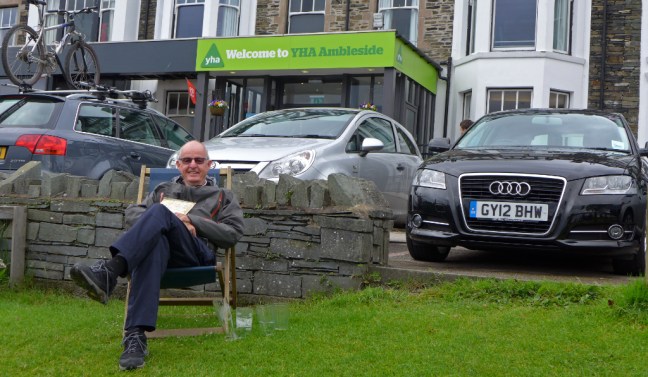
We passed Ambleside Youth Hostel pictured here many years later.
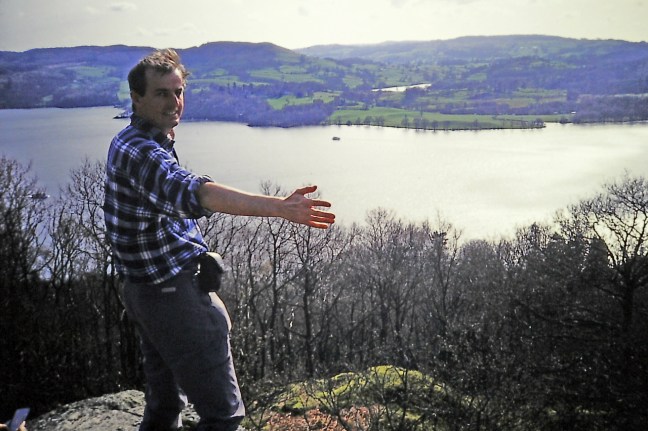
lake-district-june-2014_2097_edited-1Glad to leave the crowds of Ambleside, we climbed to Jenkin Crag where, as late afternoon sun bathed the area with its penetrating rays, we admired the views of the Langdale Pikes and the waters of Windermere.
PICT0001.1jpgThe Big 50_6774As we continued through Skelghyll Wood a red squirrel ran across in front of us, just giving me time to ‘shoot it from the hip.’ This is my photographic technique, whereby my camera is always kept attached to my trouser belt in readiness for the ‘quick photograph.’ Was it Squirrel Nutkin as featured in Beatrix Potter’s book The Tale of Squirrel Nutkin? It was certainly the right colour, although my understanding was that Squirrel Nutkin was based more round the shores and islands of Derwent Water.

Red squirrels are now quite rare in England and the last one seen on Cannock Chase, one of its few remaining strongholds, was in 1994. It is as a result of competition for food from the introduced ‘bossy’ American grey squirrel. Just as in the Olympic games the Americans tend to win, so with grey squirrels. The grey squirrel is obviously keen on world domination having started to encroach into the north of England; there are now over two and a half million nationwide, all descending from a handful introduced to Britain from North America in 1876. There are now less than 160,000 red squirrels mostly in isolated populations. Three quarters of the national population of reds is in Scotland. Greys have a more varied diet, being able to digest unripe nuts and seeds, whereas reds have difficulty living off a diet consisting mainly of acorns, preferring the seeds of conifers. Greys are immune to the parapox virus, which wipes out reds within fifteen years of their rivals colonising an area.

The walk from Jenkin Crag to Windermere Youth Hostel is a delight and here are some photographs taken on different sections.
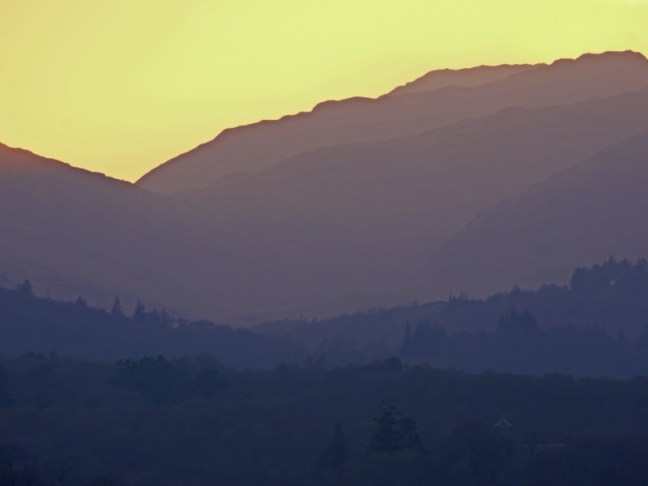
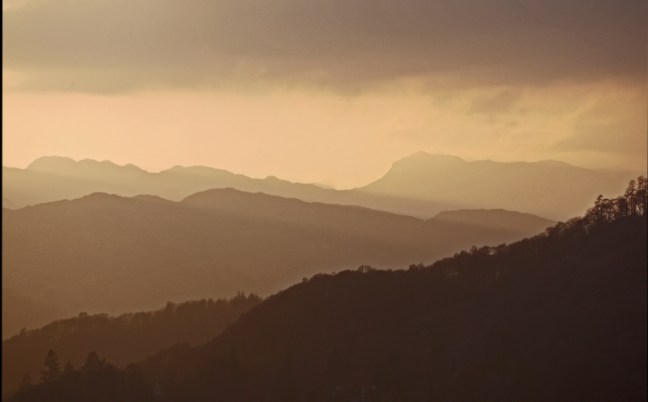
BDWW MArch 2011 Lakes-114_edited-1

BDWW MArch 2011 Lakes-110_edited-2BDWW MArch 2011 Lakes-113_edited-1BDWW MArch 2011 Lakes-092_edited-1BDWW MArch 2011 Lakes-022_edited-1BDWW MArch 2011 Lakes-017_edited-2Windermere Mist_edited-1BDWW MArch 2011 Lakes-022_edited-1BDWW MArch 2011 Lakes-093_edited-1We arrived at the ornate Windermere Youth Hostel tired but exhilarated at such a fine day’s walking, the final curtain call of the day being a lovely red sunset from the balcony of the hostel.

I feel truly blessed to experience days like this in my life.

Back to 1993 and the Jewel that is Tarn Hows.

Post 55: 1 April 1993: Day 3 – Coniston Youth Hostel to Windermere Youth Hostel – 12 ½ miles

Breakfast turned out quite eventful, as we were joined by ‘trainee’ youth hostel wardens, who were keen to try out their newly acquired customer-friendly skills. We did not resist, letting them wait on us, fetching our porridge, bacon, eggs and toast; they even poured the tea for us. We had walked over 21 miles to get there and felt inclined to take advantage of the situation!

Later on in the morning, just as we putting our packs on to leave, Gina appeared.

‘You are adventurous walking across England,’ she said.

‘No, no, you’re the adventurous one, travelling around on your own,’ I said, thinking our little expedition was nothing compared to her adventure.

‘Thanks for inviting me to the pub.’

‘The pleasure was ours, enjoy the rest of your trip, take care, bye’

With that we put on our packs and left, our spirits lifted at having met this delightful, adventurous, young lady with a keen taste for the best of Britain’s countryside.

When I was originally planning this coast to coast walk, the original intention was to head east to Hawkshead, then south-east to take the ferry across Windermere the lake, to Bowness-on-Windermere. However, one evening in the pub, the ‘Ethics’ committee decided that this would not be in the spirit of a coast to coast walk. As a result I had to devise an alternative route either north or south round Windermere, England’s largest lake. A five minute decision in the pub resulted in several months of additional route finding, research and writing up. However, the final route turned out to be one of the best sections of the whole walk, with ever-changing, breathtaking, views throughout the day. It has helped to reinforce my philosophy that in the coast to coast journey of life, setbacks often result in unexpected bonuses; as in life, when the chips are down, just keep going and things will get better again.

We left the hostel at 9.15am, ascending steadily to Tarn Hows to arrive at 10.00am for a coffee break, the first visitors of the day. As we sat on a log, sipping coffee from our flasks, I couldn’t help but think that, even on a damp and misty morning as this, the sparkling sheet of water known as Tarn Hows, intricately nestled amongst grass, rocks, trees, and mountains, was a sparkling jewel.

PICT0003

The magic of the moment was interrupted when Gina’s banger appeared on the road above us, creeping slowly along as she admired the fine views before her (not us of course). However, when on a ‘tour’ of Europe you don’t have time to savour such sights, so she turned the car round in the National Trust car park, returning the way she had come, no doubt heading for the next ‘tourist’ attraction.

Wonderful Walker, The Old Man, A Flying Saucer, Gina and Neighbours.

Post 54:

After an unpleasant squelch through the muddy forest of Grassguards (no wonder I dislike forests), a pleasant descent led to Wallowbarrow gorge and the unpolluted (rare these days) River Duddon, which Wordsworth describes as the ‘magnificent Duddon’ making a ‘radiant progress towards the deep’; it is one of twenty-one delightful rivers on the walk. I only found this out when I was compiling the index to the book, being totally astounded that there could be so many rivers en route. One of the tributaries of the Duddon, Mosedale Beck, as well as the nearby River Esk, have lovely clear pools that, on a hot day, tempt you in for a dip.

Arrival at the tiny village of Seathwaite gave us a choice of lunch-time venues, either the Newfield Inn or a log opposite the Church of Holy Trinity. We chose the latter, not because we were feeling religious, but because alcohol would not help us to climb to the top of the Walna Scar Road at over 1,900 feet. In the church is a memorial plaque to Reverend Walker, 1709-1802, (nothing to do with Walker’s crisps) who was the parson of the old church for sixty-seven years and to whom Wordsworth refers to in a sonnet as one ‘whose good works form an endless retinue.’ Because of his good works, he became known as ‘Wonderful Walker.’

The big 50_6722_edited-1
The Scafell Range from the Walna Scar Road

A long hard climb follows to the top of the Walna Scar Road, but the reward is fine retrospective views of the Scafell range. It was with some relief that we arrived on the crest of the pass but, having got his breath back, Alan decided to do a detour to bag a few summits, including brown Pike, Buck Pike, Dow Crag and the Old Man of Coniston. In order finish the walk, my priority was to look after my knee; therefore I declined the invitation to join him. In addition, I wanted to descend to Boo Tarn, hoping to get a glimpse of a flying saucer that had last been seen in the area in 1952 by a boy who had photographed it. Needless to say it didn’t appear for me as I scurried on down to Coniston, arriving at 3.30pm. I sat on a bench in front of the church, wrote some postcards, then had an ice-cream, this being one of my favourite activities on a long-distance walk.

After looking around Coniston, including the Ruskin Museum, I walked slowly in the direction of the hostel and ‘bumped’ into a young lady.

‘Are you heading to the hostel?’ I enquired, her red anorak giving the game away.

‘Yes, it’s just round the corner,’ she said in a friendly Australian accent.

‘Your not from these parts?’ I was curious to know what an Australian was doing in Coniston.

‘Oh no, I was Secretary in Australia, but have given up my job to travel around Great Britain and Europe.’

‘That’s very adventurous,’ I said.

My mind wandered; I partly came on walking holidays to escapes soaps, one of which Neighbours featured numerous Australian secretaries. They were now ‘invading’ the country in the flesh and blood, not just on television. I thought it was quite ironic that my children sat glued to Neighbours night after night, whereas I was talking to a real Australian in the middle of the Lake District.

‘Where have you been so far?’

‘I’ve just been to Hawes and Dentdale.’

‘Oh, they are on the route of the coast to coast walk we are doing at the moment.’

I was very impressed that an Australian had sought out such delightful places. Her name was Gina and she was getting about in an old banger she had bought for fifty pounds. She was about to visit many of my favourite country haunts, Eskdale, the northern Lake District, Ireland, and Scotland. Travelling alone, she said she got the bug from her mother who had also travelled extensively. She had never been to an English pub and so I invited her along.

Alan arrived at the hostel at 5.30pm exhausted, then was somewhat surprised when I asked if he had any objections if Gina joined us for a drink. At that point she appeared, so that any doubts Alan may have had immediately disappeared. Gina introduced me to Australian beers, whereas I introduced her to Guinness, and I know which I prefer.

The Finest View in England?

Post 53: A little further on Ross’s camp was reached. This is not the equivalent of a Lake District Butlin’s holiday camp, but is in fact some stones put together by members of a Victorian shooting party, who raised the massive flat slab onto the other stones to serve as a luncheon table. Of interest is that Ross, or someone, inscribed ROSS’S CAMP 1883 on it, which has survived the ravages of Lakeland weather to this day. Little is known of Ross other than he was an agent for the Muncaster Estate.

PICT0001_0490_edited-2
Near Ross’s Camp with ‘Paradise’ behind me.

We descended to pass Dalegarth Hall with its large rounded chimneys.Then there was a short detour to Dalegarth Falls almost hidden in a secluded gorge.

Continuing to St Catherine’s Church, just outside Boot, there is a unique sight in the graveyard. Here lies Thomas Dobson’s grave, the headstone being inscribed with his own portrait, a fox, a hound and a horn; a true work of art in granite. The mind boggles as to what I could have engraved on my own gravestone; my head with thinning hair, a pair of walking boots, a pint of Guinness, and last, but not least, a 65 litre rucksack. Keeping on the cheerful graveyard theme, a little further on there is a 250-year old packhorse bridge, the path crossing it being formerly the corpse-road leading to Wasdale Head. It is now used by walkers to get to the Wasdale Head pub; how times have changed.

One other feature of Boot is the corn mill restored in 1975 by Cumbria Countty Council. A corn mill has been operating in the area since the 13th century and the restored mill has a working wheel.

This was a short day and, arriving in sunshine at the Eskdale Youth Hostel at 3.30pm, we had time to wash our boots and gaiters in the nearby stream – it is important to keep up appearances on a long-distance walk. In the evening a visit to the nearby Woolpack Inn was essential to celebrate completion of day one of the fourteen-day walk. This was the start of a similar celebration on everyday of the walk!

31 March 1993: Day 2 – Eskdale Youth Hostel to Coniston Youth Hostel – 11½ miles.           When on a long-distance walk, one of the noticeable changes in my behaviour is that I seem to sleep much deeper with the result that I wake up much earlier. On this occasion it was about 5.00am, so that, as the dawn starting to shine through the curtains at 7.00am, I decided to get up and catch the early morning dew. The sun was rising at the far end of the valley and Harter Fell was beautifully illuminated. My spirits were high as I looked up at the path that would lead us past Harter Fell towards the secluded Duddon Valley. It was good to be alive and fit, with the prospect of glorious walking ahead in good weather.

After passing Penny Hill Farm, high spirits gave way to panting as we began the steep climb to the foot of Harter Fell. This should have been easy for Alan, but it was some time since he had trekked to Everest base camp and the golden rule of fitness is that it doesn’t take long to lose it, but takes a long time and much effort to acquire it. We arrived at the edge of Harter Fell, to what I regard as the finest view in England; looking up towards Upper Eskdale and the Scafell range where wisps of white cloud crowned the king of England’s mountains, Scafell Pike.

The big 50_6721_edited-1On the slopes of Hard Knott, below right to the north-east, is the best preserved of Roman forts in Lakeland Mediobognvm, commonly referred to as Hardknott Castle or Fort which acted as a defence against an approach from the coast, being built soon after AD120. I suspect the Romans wouldn’t have spent much time admiring the view as they would have been too busy looking out for marauding Scots and other unfriendly raiders.

The big 50_6733

The First Day of my own Coast to Coast, a Roman Bath House, a Complete Strip and at 84 your never Too Old .

Post 52: 

30 March 1993: Day 1 – Ravenglass to Eskdale Youth Hostel – 10 miles.

A wet start to the day.

PICT0004.1jpg

After a wholesome breakfast, we crossed the narrow road along the Ravenglass front to descend some steps to the beach. The tide was high, so that we didn’t have far to walk to dip our toes in the sea. It was not until some months later that I discovered that someone had found a Roman Diploma on this very beach. The Romans made Ravenglass their naval base for the whole of their occupation of north-west England; it was called Glannaventa. The Roman diploma was sent from Rome during their occupation of Britain between AD43 and 410 and represented a soldier’s discharge paper awarding him, after twenty-five years service, Roman citizenship. You can imagine the Diploma arriving by ‘horse-post’ and the soldier saying, ‘Well, I’ve been in Ravenglass for twenty-five years and I’ve only got to walk some 1,000 miles to get back to Rome.’

Ravenglass received its market charter in 1208, one of the first in what is now known as Cumbria.

Continuing along the pebbly beach a footpath sign came into view, a little yellow arrow stuck on a pole, half submerged in water. Not very encouraging for the start of a coast to coast walk! Fortunately, the sea could be skirted to reach terra firma.

We soon reached a Roman Bath House. The Bath House, known as Walls Castle (near Walls Mansion) is one of the highest-standing remains of a Roman building in this country and is all that remains of Glannaventa.

P1030235

The above photograph is of an 84 year old gentleman from Antrim who completed my coast to coast solo some years later in 2002 and who wrote to me enclosing this picture amongst the Roman Bath house ruins. Amazing – so I sent him a certificate of completion !!!

He said in a letter to me about his coast to coast:

‘Thank you for so much for certifying me. My son and grandsons say I’m mad anyway. He came across a child in a farmhouse who played trombone so he joined in. The men of the house in the Dentdale B&B played cornet. His worst experience was climbing over the the hills to Coniston in drenching driving rain only to find the hostel closed until 5.30. His best experience was that of walking into the drying room, locking the door, stripping to the skin, and turning up the heat. Fully changed and dressed, sitting down to a marvellous meal cooked by mine host. Truly memorable’.

His last bed and breakfast insisted he phone in his arrival at Scarborough at the end of the walk as they were worried he would get lost in the woods.

His next planned walk in 2003 was the up West Highland Way in Scotland and down the Lowland Highland Way. Incredible as he would then be aged 85.

Your never too old for long-distance walking!

Back on my own coast to coast a gentle climb led to Muncaster Castle, an enormous granite and sandstone structure, which surprisingly houses an owl centre, home to the World Owl Trust. In the castle are beautiful tapestries, furniture and paintings. In 1464, Henry VI hid here and, in gratitude, presented the lovely glass ‘Luck of Muncaster’ bowl to Sir John Pennington; a replica is on view. It is said that as long as it is intact the Penningtons will live and thrive there.

From near the castle terrace, Ruskin described the view north-east to Scafell as ‘the finest in England’, this he felt was the entrance to Paradise; clearly he didn’t say this on a wet Lake District day, when the only thing you can see is rain dripping off your nose. A further climb led up to Hooker Crag. This is not a hill where ‘ladies of the night’ gather (as far as I am aware), but is in fact a fine viewpoint looking towards the Isle of Man out to sea and the Scafell range to the north. A little more worrying, Sellafield nuclear power station can be seen to the north-west and it is noticeable that glowing red skies are very frequent in this area – I would not of course suggest there is a connection. One of the notable features about the Lake District is that you can often see the weather coming towards you and, on this day, fine blue skies were heading towards us and were to stay with us for many days – wonderful!

How do do find time to complete a long-distance walk and keep your wife happy?

Post 51: April 1993 – On Foot From Coast to Coast – The North of England Way – a ‘New Man’, aged 41

Whilst recognising that on Wainwright’s Coast to Coast Walk you start as a boy and finish as a man, on my coast to coast you start as a man/woman and finish as a younger man/woman, in spirit if not in age. You finish as a ‘New Man’ or ‘New Woman’.

How do you devise a 200-mile walk, complete the walk, then write a book about the walk, all with a full-time job, a wife who works full-time, household chores to do, a dog that needs walking twice a day, two teenage children who need ferrying here and there? Answer: with great difficulty.

The dog walking is no problem as the walking gets you fit, the children don’t mind as long as you do what they want in between walks, the wife may grumble a bit or a lot when you keep disappearing to the computer and away for days and weekends mapping and walking. However, she will forgive you if you do a lot of the ironing, hoovering, washing, shopping and other household chores. So how do you fit all these in?

Never go up or down the stairs without carrying something, such as ironing to be put away or washing to be hung. Never iron things that don’t really need ironing, such as underpants. Buy a dishwasher and microwave. Hoover and dust rooms first that will get dirty again last, for example, bedrooms.

Only twenty-six per cent of men do the weekly household shopping, dropping to eleven per cent of men who have families. If, like me, you are one of the eleven per cent, then do your shopping at 9.00am on a Saturday morning; any earlier, then only one till will be open and you will have to wait for the two people who are always in front of you. If you leave it later in the morning there will be lots of customers resulting in the tills always being busy. Always try to arrange dusting of the living room, ironing and writing Christmas cards to coincide with watching television (often recorded programmes) or listening to the radio. Otherwise you are wasting time; time you haven’t got. When having a day out walking, leave early in the morning (ideally 7.30am, 8.00am at the latest) to avoid traffic jams, thus enabling you to get back early to enable you to keep the wife and children ‘happy.’

Avoid general shopping trips, during which you wander around looking at things but never buy anything. Women in particular are prone to this activity, which has become one of the country’s leading leisure pursuits. To me it is simply a complete waste of time. If you need something, head to the shops and buy it, but don’t go to twenty shops looking at everything only to return to the first shop to buy the article.

A more drastic alternative is not to get married, not to have children, then in theory you should have plenty of time to indulge in walking.

More conventional is to leave the walking until the children have left home, although by that time you will be too unfit for really serious walking and your wife may have got too used to having you around.

Having sorted all these domestic chores out, you are ready to embark on yet another adventure, to experience the freedom and excitement of devising your own long-distance walk. Here is my story.

(Update: in theory, internet shopping and home deliveries in more recent years have made fitting everything in a lot easier).

29 March 1993

Farewells to the family as I left; your mind racked with guilt for abandoning them for a week or so. This guilt does diminish over the years as, when your children become teenagers, you can’t wait to escape some of their annoying habits; not least music so loud your eardrums nearly burst.

Travelled on the train to Leeds, then on to Preston where Alan joined me. It was with a little trepidation that we arrived at a wet Ravenglass station at 3.30pm to embark on this long-awaited adventure – my own coast to coast walk. I was still uncertain whether my knee would withstand 200 miles of walking across England. I also wondered whether my coast to coast route would meet all the original objectives I had set, the overriding objective of which was to select the best southerly coast to coast route. I was not to be disappointed and, indeed, with excellent weather for most of the fourteen-day walk, all my expectations were exceeded.

BDWW MArch 2011 Lakes-088_edited-1
Ravenglass Sunset


BDWW MArch 2011 Lakes-086_edited-1In the evening we went to the Ratty Arms pub, near the Ratty museum and railway station. Ravenglass is the western home of the Ravenglass and Eskdale Railway, England’s oldest narrow-gauge railway. With a gauge of 15-inches, it’s a bit like riding on your son’s Hornby train set with wind blowing through your hair and beautiful scenery all around. If enthusiasts can make such a small train line profitable, why couldn’t British Rail (as it was then) keep their country lines open in 1963 when Beeching axed many of them?
 

A Nagging Pain, Frozen Peas on Naked Knees, a Wedding, and the Last Day before my Own Coast to Coast.

Post 50: 23 January 1993

The nagging pain in my knee returned, making me feel quite depressed; I couldn’t understand why it was still there. I booked in to see the Doctor again. Again, he advised keep walking.

25 January 1993

Utter despair. I walked 4 miles on Saturday and Sunday with no problems, but by Monday I was in agony again. I was ninety-nine per cent certain my walk would be off.

28 January 1993

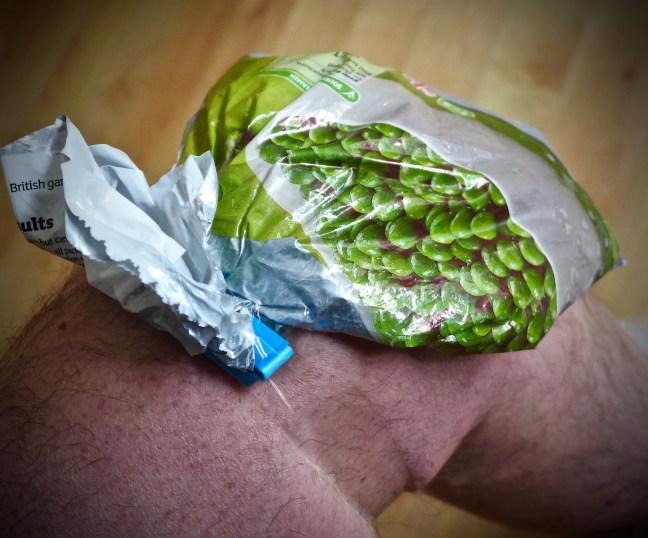
A small miracle seems to have happened. After over four weeks of pain, this is the first day I haven’t had any. I spoke to a former colleague, now a physiotherapist, who advised frozen peas to reduce the swelling and it worked!

P1030137

He also recommended special leg exercises, which also helped. I was still waiting to hear from the National Health Service physiotherapist. I have never fully understood the NHS waiting list system, which seems to work on the basis that you get better before you are attended to; no wonder statistics show waiting lists are coming down, everyone is getting better before they are attended to. Time can be a great healer.

31 January 1993

By this time I was very optimistic about doing the walk. All pain has gone from my knee and I had done some reasonable walks with my dog. I was really excited at the prospect of two weeks of walking on a virgin route.

1 February 1993

However, there was now a setback. Alfie didn’t think he could make the walk as he was smitten by a new lady in his life; it sounded very serious. The matter was put to the ‘Ethics Committee’, which ruled five years could be given off from long-distance walking for marriage, provided members were invited to the wedding. Alfie was left with no choice; he proposed, she accepted and he was therefore excused from the walk. I couldn’t help but question his commitment to long-distance walking, but then he hadn’t had the best of times on Wainwright’s Coast to Coast walk.

5 February 1993

I woke up with a sore throat and aching all over, a virus? Wainwright used to say that he never had a day off work and put it down to the beneficial effects of walking. I also had an excellent attendance record at work and again felt this was due to the health giving properties of walking, minimising the effects of viruses, colds and other ailments that seem to keep other people off work for days. Statistics show that the average person has something like eight days off work per annum, whereas I averaged one day every three years. Usually, when that aching feeling comes over an early night and lots of fruit juice seems to cure it. I desperately needed to get out for a long walk on Sunday to test my knee, otherwise I couldn’t go for another three weeks.

7 February 1993

I was now feeling much better. It was glorious February morning, mild and sunny. To test my knee out I went for a walk from Crosscliffe Viewpoint on the North York Moors. The smell of the pine trees and morning dew seemed so strong. It was great to be out in the country again with its smells, sights and sounds. I didn’t feel one hundred per cent, but we pressed on for 8 miles and my knee was okay. Only seven weeks to go and, although I’ll never be as fit as I hoped, there was a good chance I could at least start the walk. If Ranulph Fiennes can walk unsupported across Antarctica, surely I can walk coast to coast?

28 February 1993

Snow everywhere so we couldn’t go to the North York Moors as planned but still managed a 15-mile local walk. Knee okay, things are looking good.

6 March 1993

Went to the North York Moors for another walk, near Dalby Forest, My knee was okay apart from one or two twinges in the evening.

13 March 1993

This was my final walk on the North York Moors, before embarking on coast to coast. No problems with knee.

28 March 1993

This was the day before coast to coast. Weather forecast is for an unsettled first week. I felt a little anxious. Would my route and knee hold up? However, once I start walking there would be a sense of freedom and excitement, similar to when I hitch-hiked solo to Europe when I was eighteen or when I toured New York and Canada at the age of twenty.

Dad’s Football Match followed by a Visit to Hospital

Post 49: 28 December 1992

This is a time for reflection. I am sitting in York District Hospital Casualty Department with my left knee the size of a balloon.

The receptionist, who happens to live in my village, was clearly amused at my predicament.

‘Oh, what have you been doing?’ she said, as though I was a naughty little boy. York is one of those places where everyone knows your business.

‘Playing football.’

‘What at your age?’ she said.

‘I was in the dad’s football match, a mistimed tackle just as I was about to score a goal did the damage.’ I said. ‘I was only on for five minutes. I have a history of ligament problems due to jumping off sand dunes; but my wife and children persuaded me to take part.’

When I was seventeen I went on a school geography field trip to the University of Swansea and, whilst surveying a beach, I went for the longest long-jump off a sand dune, but instead badly strained my knee ligaments. My career in sport, as a member of the school football team, basketball captain and keen tennis player, was ended on that fateful day. Since then, I have avoided serious twisting sports, until I was reluctantly persuaded to play in the dad’s football match. As a result, I was again in hospital with a suspected ligament injury. I no longer felt a ‘New Man’. In fact I felt a very old and frail man. After about two hours, a young doctor came to see me.

‘What have we been doing here?’ the doctor said, prodding my knee until I winced, again making me feel like an errant little boy.

‘I was in the dad’s football match and, after a mistimed tackle, pirouetted to end up on the floor.’

‘Ah, I see,’ he said, again feeling my knee to make me grimace. ‘I think you have a bad strain of the crucial ligament. It’s a common football injury, Gazza, Brian Clough and a number of other footballers have had it.’

‘What can be done about it?’

‘Well we could operate, but it’s not worth it on you. Just completely rest it, bandaged up, for two days, then gradually start to use it, but don’t do any twisting sports such as football, badminton, or tennis.’

‘What about long-distance walking?’

‘Yes, couldn’t be better, as long as you build up gradually.’

‘Great, I have a 200-mile coast to coast walk at Easter. Will that be okay?’

‘You’ll have to see.’

1 January 1993

It was a bright sunny day. Having spent a week on the sofa with my leg supported in the air, I was desperate to get my legs moving again. I only had three months left before I was due to walk 200 miles from Ravenglass on the Irish Sea to Scarborough on the North Sea.

After two years of scouring maps, completing day walks and undertaking extensive research of churches, pubs, villages, and breweries, my draft coast to coast guide book was completed; now I wanted to walk it in its entirety. I hobbled along with my cross bearded- collie/whippet tugging me along, a sorry sight (no not the dog) and hardly the ‘New Man’ I was supposed to be.

4 January 1993

Back to work. I could only just manage to drive the car. Coast to coast seemed a remote possibility, but at least my knee was no longer balloon size.

16 January 1993

It was time to see the Doctor. Although I was able to walk short distances of half-a-mile or so, there was often a nagging pain in the knee, like toothache.

‘Will I be able to walk 200 miles coast to coast at Easter?’ I said anticipating a firm no in reply. Was this the end of my dream of walking my own coast to coast route. This had been an obsession, like an itch that you have to scratch and can’t leave alone.

‘Yes, it should be okay by Easter, just keep walking,’ he said surprisingly. ‘Did I tell you about the time I was in the Cairngorms when the wind was so bad we had to crawl on all fours using ice-axes?’

I suddenly realised the advice I was being given to me was by one of those crazy rock climbing types who believe everything is alright, until they stop breathing. Broken legs, ribs, arms etc. don’t stop you climbing or walking; you only stop when rigor mortis has set in.

Some encouragement was better than none, so I began doing longer walks, first half-an-hour, then three-quarters of an hour, an hour and then an hour and a quarter.


April Fools Day, the Last but Most Difficult Day and a Black Eye


Post 48: 1 April 1992: Day 5 – Caldbeck (Whelpo) to Carlisle – 20 miles.

After a good breakfast and knowing this was our last day, spirits were high. We had completely forgotten it was April Fools Day. This was a mistake because the rain, sleet and snow were torrential. With a train to catch at 3.30pm and 20 miles to walk we left the bed and breakfast at 8.30am.
Passing through Parsons Park, a young deer ran across our path and a red squirrel shot up a tree in front of us. The path descended to the River Caldew and I noted the comments in the guide book:

‘The banks of the River Caldew are subject to erosion. This necessitates minor diversions from time to time, which cannot be anticipated on the map or within the text.’

Gary was heading nearer and nearer to the raging torrent that called itself a river. Soaking wet from the torrential rain he was in great haste. I suddenly realised that he was getting dangerously close to the river, so that if he slipped his pack would drag him to the bottom and he would never be recovered alive.
‘Stop!’ I shouted as loud as I could above the roar of the gushing water.
‘What?’ he replied.
‘We can’t carry on along this path as it goes too close to the river and we might slip in. I think its best we go back and find another route.’
Gary grunted as he was clearly unhappy with this, never liking to go back over a route he had already done. I would have preferred to go back further.

‘Okay, then let’s try climbing this bank,’ I said noting his reluctance to go back. I started to clamber up a steep muddy bank. My boots slipped and the weight of my pack suddenly made me realise that this was a mistake. Under my breathe I cursed Gary for not agreeing to go back further along the proper path. It is at times like this that real friendships are tested. I grabbed a branch to give me some leverage, then suddenly there was a snap and blinding flash.
‘You alright?’ Gary said.
I swore under my breath. ‘ What do you think?’ I said grasping my eye, which had been hit by the branch. ‘Oooh…..’ my eye was stinging, watering and couldn’t be opened. I began to think walks in the country shouldn’t be like this. After about five minutes, I managed to open the eye and was much relieved to find I could still see.
‘You’ve got a black eye,’ Gary said.
‘Great, that’ll take some explaining to my wife.’
Eventually we reached a better path and started to follow it along the valley until it dropped down to the river again.
‘CAUTION’
A sign said as we reached a landslide of mud and trees that went straight into the river. Was this the Himalayas or the Lake District I thought to myself? We cautiously found our way through the mud realising that one slip and we were goners in the river.

It was with great relief that we left the mud and forested area to stop for a miserable, wet, refreshment break perched on a rock.

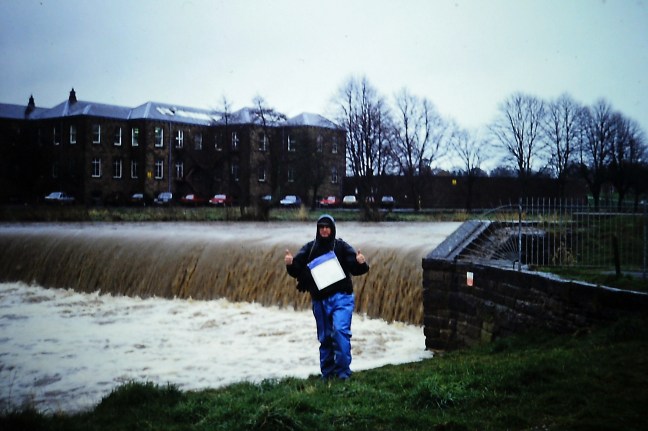
After that it was head down, best foot forward, as we raced through puddles, rain, streams and mud to reach the end of the walk in Carlisle at 2.30pm. 20 miles completed in six hours. A weir looked like Niagara Falls as we posed for photographs in front of it, pleased that, despite the atrocious conditions, we had managed to finish the walk. Having forgot his gaiters, Gary’s trousers were brown with mud up to the knees.

The big 50_6767_edited-1
Finished!


The Cumbria Way 1992
The River Caldew in full spate. The end of the Cumbria Way 1992

Next stop was the railway station, where we headed for the gents loo to change into some dry clothing. At this point, Gary realised he had lost his glasses and I realised all my maps were soaked through. From there we went to the snack bar for some warming soup, then it was on the Carlisle – Settle train, with connections to York.

When I got home I turned out my clothes into the linen basket, next to the dog’s basket. The dog refused to go on his basket. I know dogs have sensitive smell, but I hadn’t realised it was that sensitive!
It took only one day to recover from the hardships of the walk, then I started to look forward to the next one – my own coast to coast walk!

England’s Highest Youth Hostel, Taking the first Plunge.

Post 47: 31 March 1992: Day 4 – Keswick Youth Hostel to Caldbeck (Whelpo) – 17 miles.

One of the good things about staying in youth hostels is that you meet walkers from overseas and, during the course of the evening, I met a German couple, an Irish lady, and a Finnish lady. Just as we were putting on our boots to leave, the three ladies all came over and wished me well and said goodbye; Gary was somewhat surprised as he hadn’t met any of them.

Having heard the weather forecast of rain, high winds and snow, I was inclined to take my boots off and stay another night, especially as the company was so friendly. However, dedicated long-distance walkers can’t let such distractions get in the way and we left the hostel as late as we could, at 9.45am.

As we climbed Latrigg Fell, the rain started and we donned our wet weather gear. By the time we started skirting Lonscale Fell, the rain had turned to sleet and snow and a howling wind was hitting us from the north.

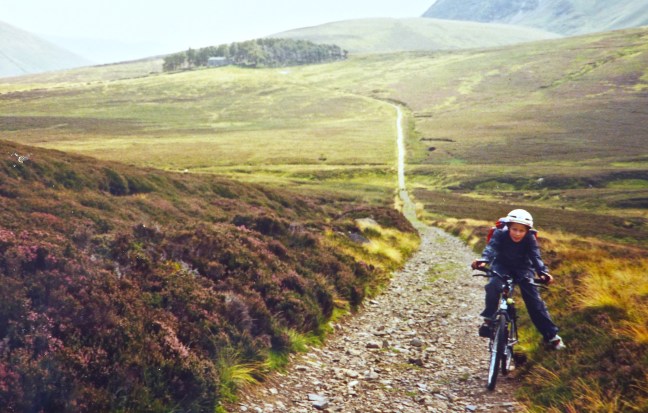
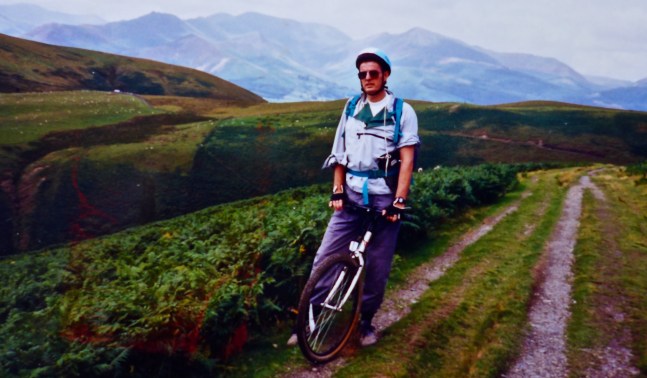
The weather was so bad I was unable to take photographs but here are a few taken on a mountain biking expedition with my son in much better weather.

P1020595
Clmbing towards Latrigg Fell .
P1020596
Skiddaw

Arriving at Skiddaw House Youth Hostel, the highest in England at 1550 feet, we were relieved and delighted to find it open.

P1020592
Skiddaw Youth Hostel

Although we had only walked 6 miles, we felt as though we had walked 60. A group of youths on a Duke of Edinburgh Awards expedition were crowded around a portable gas fire and seeing our sorry state kindly moved over to let us dry out. Sitting two inches from the fire, Gary looked as though he was suffering from hypothermia, his socks and other clothes steaming, as he supped hot soup. The cost of an overnight stay at the hostel was £3 but I decided to donate this to the hostel, just for having let us get out of the horrible weather for half-an-hour. The contrast from the commercialism of town cafés could not have been more apparent. Skiddaw House Youth Hostel used to be a shooting lodge, then fell into disrepair before the Youth Hostels Association and friends of the hostel brought it back into use. Even so it still only has 24-volt lighting and the nearest pub is six miles away. Every time I go there improvements seem to have been carried out by a dedicated warden and if you want to get away from it all there was no better place than here, at ‘the back o’ Skiddaw’.

P1020594
Much better going through the stream rather than over the nearby bridge
P1020591
The long track leaving the hostel in the distance before a very steep and fast descent past Dash Beck

P1020590Due to the poor weather, we decided to follow the ‘low-level route’, then, as we descended to Dash Beck, seven girls on a Duke of Edinburgh Awards expedition passed us ascending towards the hostel. You can’t help but wonder if the Duke had masochistic tendencies as these poor youngsters always seem to be out camping in bad weather. A few days later we heard that two girls had to be stretchered off the fells near Keswick that night, suffering from exposure and hypothermia. This was not surprising as we met a local who said that the weather that day had been the worst all winter. I thought it was April fool’s day tomorrow. Chris Bonington lives somewhere in the Caldbeck area and, having survived this sort of weather, no wonder he has become one of the world’s top mountaineers.

It was with great relief that we arrived at our bed and breakfast accommodation at Whelpo, just outside Caldbeck. The sight of the huge sunken bath cheered our spirits no end. However, Gary took the first plunge, filled it to nearly overflowing, in the process using all the hot water. This seems to be a regular occurrence for me on long-distance walks, I must go on an assertive training course in order to learn how to get the first bath.