Post 15: At Cowgill, the Dales Way leaves the road and I thought Gary might have been there. How would he know which route to take? I waited fifteen minutes but when he didn’t appear I decided that, without maps, he would have stuck to the road. For the next four miles I encountered awful road walking in heavy rain, so I cursed Gary for forcing me to use this route. He had broken the golden rule of walking that you should stick together. I eventually arrived at Dent, noted for the block of Shap granite in the centre of the village, which perpetually spouts water and is dedicated to the geologist Adam Sedgewick. On a soaking wet day this is about the last thing you want see.
The perpetual spouting stone and Celia.
The other famous people in these parts are the ‘terrible knitters’ of Dent, so called not because they were useless at their craft but because of an older meaning of the word which indicated the great speed at which they worked, at home or while even attending cattle.
Equipment used by the Terrible Knitters of Dent
As I walked around looking for Gary, I half expected some frenzied females to come hurtling out of their houses to stab me with their knitting needles as in a Hollywood horror film, The Dent Psychopaths.
So I don’t get into trouble, the lady in the picture perpetually spouting is my wife Celia, not a Dent psychopath or a frenzied female. She nearly qualifies to be a ‘terrible knitter’, although not of Dent. Oops now in trouble. What I meant to say is she is standing next to the Spouting Stone and is a quick knitter!
There was no sign of Gary, perhaps he had been removed by the ‘terrible knitters’? This was getting serious as, without maps, his walk would be at an end. I would then have to keep my own company, which, at the best of times, is not very exciting. After ten minutes wandering along the cobbled streets of Dent, I decided I would give it a further five minutes, then I would be on my way. After four minutes and fifty-nine seconds, I put one foot in front of the other to leave Dent, then, from a pub, emerged smiling Gary.
‘Over here,’ he said gleefully.
‘Where have you been?’ I replied angrily.
‘In there having coffee,’ he said innocently.
‘Why are your trousers that funny colour?’ I enquired, thinking to myself he must have been caught short.
‘I got soaked in all that rain, but I’m drying out now.’
‘You could have fooled me.’
After splashing out on a cup of coffee for me, I forgave him, but only just. It was a symptom of our state of minds and bodies that we had coffee, not the locally produced Dent brew.
POST 14: 10 April 1990: Day 3 – Dent Youth Hostel to Grayrigg – 24 miles
Despite us feeling exhausted in the morning, the warden of the hostel showed no mercy, giving us the onerous job of hoovering the lounge. This was like being at home. However, as a potential ‘New Man’ I whizzed the hoover around and felt pleased for having helped. Gary, not a ‘New Man’, seemed to disappear for a long session on the toilet until all the work was done. Fortunately, most hostels no longer require jobs to be done. However, if you go back to the original hostel rules, first described many years ago in a publication ‘Youth Hostels in Lakeland’, third edition, price one shilling, it is a very different story.
‘Foreword
We want our guidance of you to be gentle, since we know people, and especially young people, are apt to shy away from anything which resembles education, control and regimentation when they are seeking a holiday (sounds like my teenage son!).
Regulations
Youth Hostels are for the use of members who travel on foot, by bicycle or canoe; they are not for members touring by motor-car, motor-cycle or any power-assisted vehicle (if this was still in force the hostels would be nearly empty).
No one may stay more than three consecutive nights at one hostel, except at the discretion of the warden (what a warm welcome!).
Members who have contracted, or been in contact with, an infectious disease must not use hostels during any part of the quarantine period (a bit worrying this one).
Members arriving or returning after 10.00pm without the previous consent of the warden, are liable to be refused permission or fined one shilling and reported to the Regional Secretary (this would be a serious curtailment of our evening activities and fortunately has been significantly relaxed. However, I would be quite happy to return to these rules if meal prices were as then, one shilling and nine pence each for breakfast and supper and nine pence for lunch packets).
Hostel Duties
There is often a special place for special kinds of scrap and if the containers are not plainly marked then please explore the containers to make sure that you are not dropping your paper, tins, or plaster dressing in amongst the scrap food! (The spirit of exploration was even extended to disposal of waste, clearly the YHA were one of the first organisations to be into re-cycling).
The peeling of potatoes seems to be regarded by members with mixed feelings, but despite its age-long association with servitude we would rule that this particular hostel duty is amongst the best of hostel duties. One can, at least, sit and talk whilst it is being executed, and in the process one can pick up quite a deal of useful information. It is admittedly one of the lengthiest of hostel chores, but if the company is good, and it usually is, that can be an advantage. Washing-up is another important and rather heavy duty, but wardens usually allot plenty of hands to this task. It needs to be organised pretty well if it is to be done speedily and economically. Hot water should not be wasted by running of hot water into the washing-up sink and subsequently you are not to be faced later by cold water; the process should be reversed if you are not to be faced later on by cool water emerging from the ‘hot’ tap when greasy plates still have to be washed. (This seems excellent advice as some conception of times past would not go amiss with many of today’s cloistered teenagers. My son has great difficulty loading and unloading our dishwasher, something many of the larger hostels now have).
Sweeping duties need a little thought; this point needs stressing for the benefit of the newcomer to hostelling who, landed with the not really exacting job of sweeping a dormitory, passage, stairway or a dining or common-room, often feels over-faced when he has the job of facing a shifting mass of fellow-hostellers and apparently has to sweep around or under them, or just be polite, and ease off his work so that the job is unduly lengthened and probably something is skimped. It is best to wait a little while until the traffic has thinned out a little, and the waiting time can always be employed in finishing off your own packing.’
Having diligently carried out my duties, we left the hostel in mist and rain. I immediately took my waterproof trousers out of my rucksack and it was at this point Gary said he had forgotten his and left them at home. On finding this out the heavens opened and, so as not to have to wait for me to put my trousers on, he made a hasty decision to meet me in Dent. The fact neither he nor I had a clue where Dent was didn’t matter. I wasn’t concerned as I had the maps; Gary wasn’t concerned either, but should have been. As I completed putting my waterproofs on, I saw his figure disappear at fast pace into the mist and rain; he was obviously contemplating a warm dry pub, compared to a wet road.
Post 13: As we started to climb the blisters on my heels rubbed more painfully and Gary seemed to use this as a cue to increase the pace. Showing no mercy, he began to stride out, full of energy and in sickeningly good spirits, whilst I began to curse him under my breath and focus my pain and anger on him. It did the trick as we made good progress towards Cam Houses, at which point, some 14 miles into the day’s walk, we stopped for lunch. This was my usual youth hostel packed lunch of rolls, crisps, cake and an apple (if they give you an orange take it back. The horrible things give you sticky fingers and squirt orange juice over your expensive waterproof jacket). Had we been doing the walk ten years later, the owner of the Cam Houses Farm would have supplied food and drinks, such is the growing popularity of long-distance walking. However, they have yet to provide a masseuse, which would have been most welcome at this point. One day an entrepreneur will open a massage parlour on The North of England Way, Pennine Way or Coast to Coast Walk and make an absolute fortune. Who needs a massage in the Cities? It is long-distance walkers who have a real need for a massage to ease aching and tired muscles.
A steep climb, then gentle descent, brought us to the spaghetti junction of footpaths on the Cam High Road, where the Dales Way, Pennine Way and The North of England Way meet. The Cam High Road is a Roman road and was known as the Devil’s Causeway where, in medieval times, wolves roamed and howled. The only devil I saw was Gary keeping up a horrendous pace and the only howling heard was from me in response to the pain from my blisters. You can’t imagine tough Roman centurions suffering from blisters, but I expect they did.
As we descended to Gayle Beck the mist started to envelope us. With tiredness creeping on and over 3 miles to go, an ascent onto open moorland near High Gayle was the last thing we wanted. On reaching a stile, beyond which all I could see was impenetrable mist and featureless bog, I said we had better take a compass bearing. Gary was clearly frustrated at the delay and didn’t want to stop for a compass bearing.
‘The paths over there,’ he said.
‘Hm…. possibly,’ I said trying delaying tactics, whilst I rummaged in my rucksack for my compass.
‘It must be over there,’ Gary said, getting cold and ever more impatient. I tried not to get flustered but was feeling harassed, tired and hungry.
‘No, I think you’re wrong,’ I said not very confidently, ‘if we head north instead of west along your path we should hit a lane’
We proceeded north through a squelching bog, aptly named Stoops Moss, and, as my knees sunk further into the quagmire, I thought maybe I was wrong. However, two further stiles were reached which, according to our guide book, should have been the North Yorkshire and Cumbria boundary. There were no customs or passport controls and had we been into drug smuggling we could have got through scot-free. Some years later I returned to this bog in dry conditions to see the good views of Ingleborough. After further scrambling over moss grass and bogs, we at last reached the lane leading down to Dentdale Youth Hostel.
Dent Head Viaduct, Dentdale
Had we taken Gary’s path we would almost certainly be wandering around the bog to this day, albeit as the ghosts of Gary and myself. As it was my feet were in such a poor state that in the evening, I couldn’t even walk a mile along the road to the Sportsman’s Arms. Gary did obtain liquid refreshment there at the end of his ‘thirsty’ day, but with 24-miles planned for the next day, all I could manage was to climb into my bunk.
Post 12: 9 April 1990: Day 2 – Kettlewell Youth Hostel to Dent Youth Hostel – 21 miles
In the morning Gary tried to lift his rucksack onto his back and, as the dormitory was too small even to swing a cat, succeeded only in propelling his flask in my direction. It dropped short, landing on the wooden boarded floor with a tinkling crash, shattering into tiny particles.
‘Where were the carpets?’ Gary said. This was a basic category hostel in 1990 and carpets were not part of the package.
I spent a good half hour patching up the blisters on my heels with ‘second skin’, something akin to a jelly-fish squeezed between plastic sheets. Gary was as impatient as ever to get away and, despite reminding him that there was an outdoor shop nearby where he could get a replacement drinks container, he couldn’t wait the five minutes for it to open. This decision was to change his life for the next six months in a way he could never have imagined.
The next section of the walk along the River Wharfe was relatively flat and we started in good spirits. Ladder stiles were in such abundance I thought I was doing the Grand National and each one gave rise to moans and groans as we climbed up, did a 360 degree turn at the top, then descended backwards. We sped past the lovely village of Buckden, nestled below the imposing mountain of Buckden Pike, and arrived at Hubberholme with its fine church and inn.
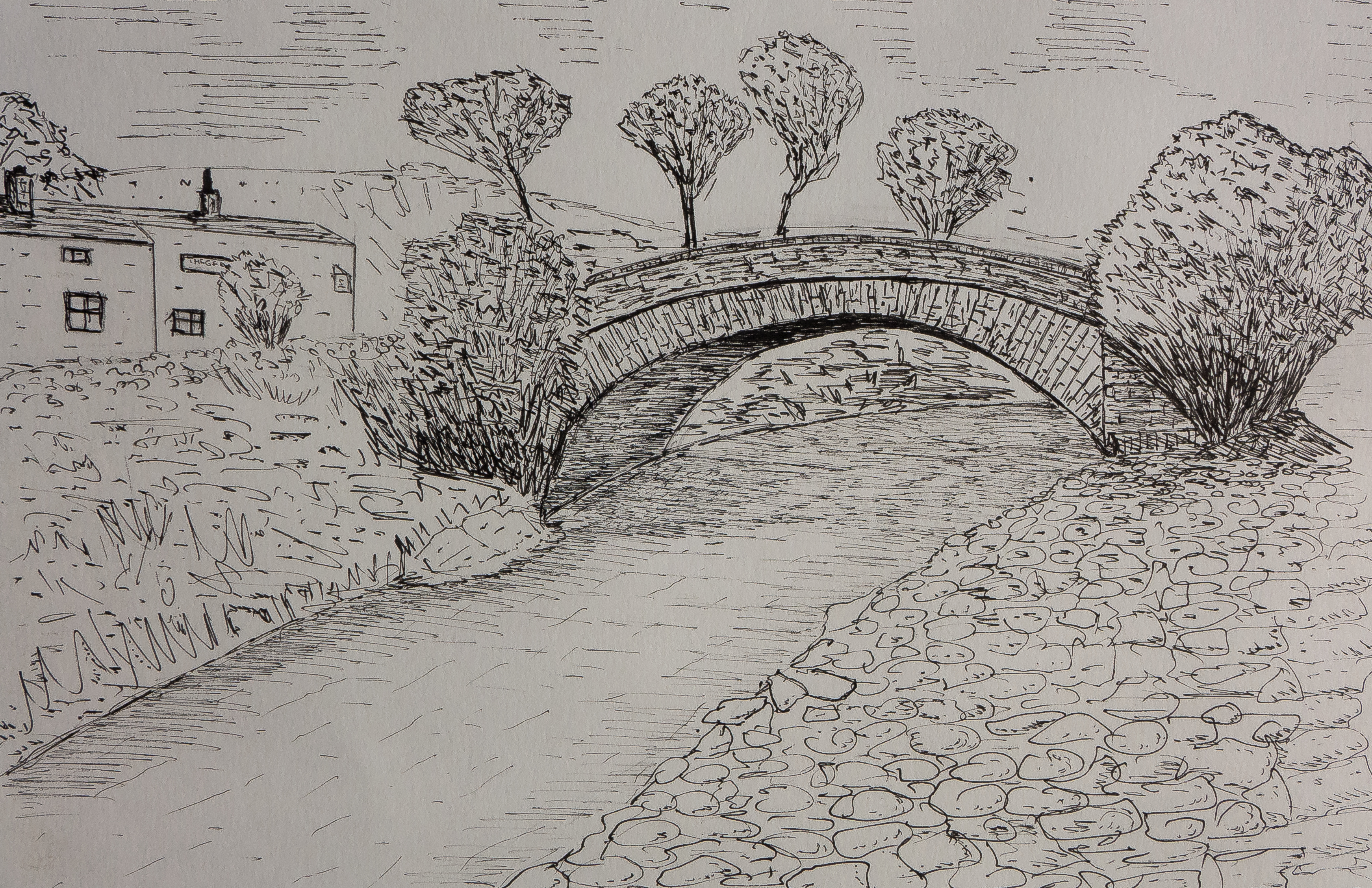
Hubberholme Bridge and the George Inn
Hubberholme’s claim to fame is that author and dramatist J. B. Priestley (1894-1984) loved the Dales and found Hubberholme to be one of the smallest and pleasantest places in the world; there is a plaque dedicated to him, his ashes being buried nearby. Denis Healey, Chancellor of the Exchequer between 1974-9 and Deputy Leader of the Labour party between 1980-3 also spoke very highly of this area of the Dales. While politicians cannot always be believed, on this occasion he was correct; from Hubberholme along the Wharfe there is some lovely riverside walking. Another notable feature of Hubberholme is that almost all the woodwork in the church is modern oak, made by Robert Thompson of Kilburn in 1934 and his signature, a tiny mouse, can be discreetly identified on many of the pieces. Why someone should put mice everywhere is beyond me as most people in the country hate the site of mice and try to kill the vermin; however, the ‘mouse man’ has done rather well with his ‘logo’.
Having walked 6 miles, the lovely hamlet of Yockenthwaite was reached where it was time for our morning refreshment; I took out my flask and made a brew of tea. Now it is important to realise that on a long-distance walk it is everyman for himself and you only pack enough food and drink for yourself to see you through to the end of the day’s walk. At this point, Gary wandered down to the stream and, not having brought his fishing rod, I could only imagine he was going for a wash. He bent down on all fours with his head in the stream.
‘What are you doing?’ I shouted.
No response. Had he decided to end it all there and then by drowning himself?
‘Hey, what are you doing?’ I screamed.
He dragged his head out of the freezing water and spat out, ‘Just having a drink.’
‘What, out of there?’ I said horrified, pointing at the stream.
‘Yeh, what’s wrong?’
‘Haven’t you noticed this is sheep country, there’s bound to be a dead one up-stream.’
As usual, taking no notice of my advice, he said, ‘Don’t be daft, this water is alright’ and plunged his head down to the stream to have another gulp. With no container to carry drinks and no sign of a Yorkshire Dales oasis or pub, I suppose this was the next best alternative. I thought to myself he should have waited until the outdoor shop opened in Kettlewell and bought a drinks container. Alf Wight the real James Herriot, the world’s most famous vet, used to drink from streams in the 1940’s when on his rounds. He ate Wensleydale cheese and digestive biscuits, which I think must have sterilised the water. Gary did not have any water steriliser and the incident was soon forgotten as we began the ascent towards Cam Houses at 1450 feet.
Post 11. A further mile on we reached Grassington with its many pubs, tea shops, cafés and craft shops, a good excuse to have another rest and sample the peach ice-cream on sale. You don’t have to go to America these days to try a variety of ice creams. Sitting on some benches around a tree in bright sunshine, we chatted contentedly to a couple who were convinced that eight miles walking was their limit and that to walk twenty-four miles in a day was madness. Putting on a brave face, I said it was just practice that was required, not telling them that it was Gary’s stupid idea to walk this far in one day. They were suitably impressed.
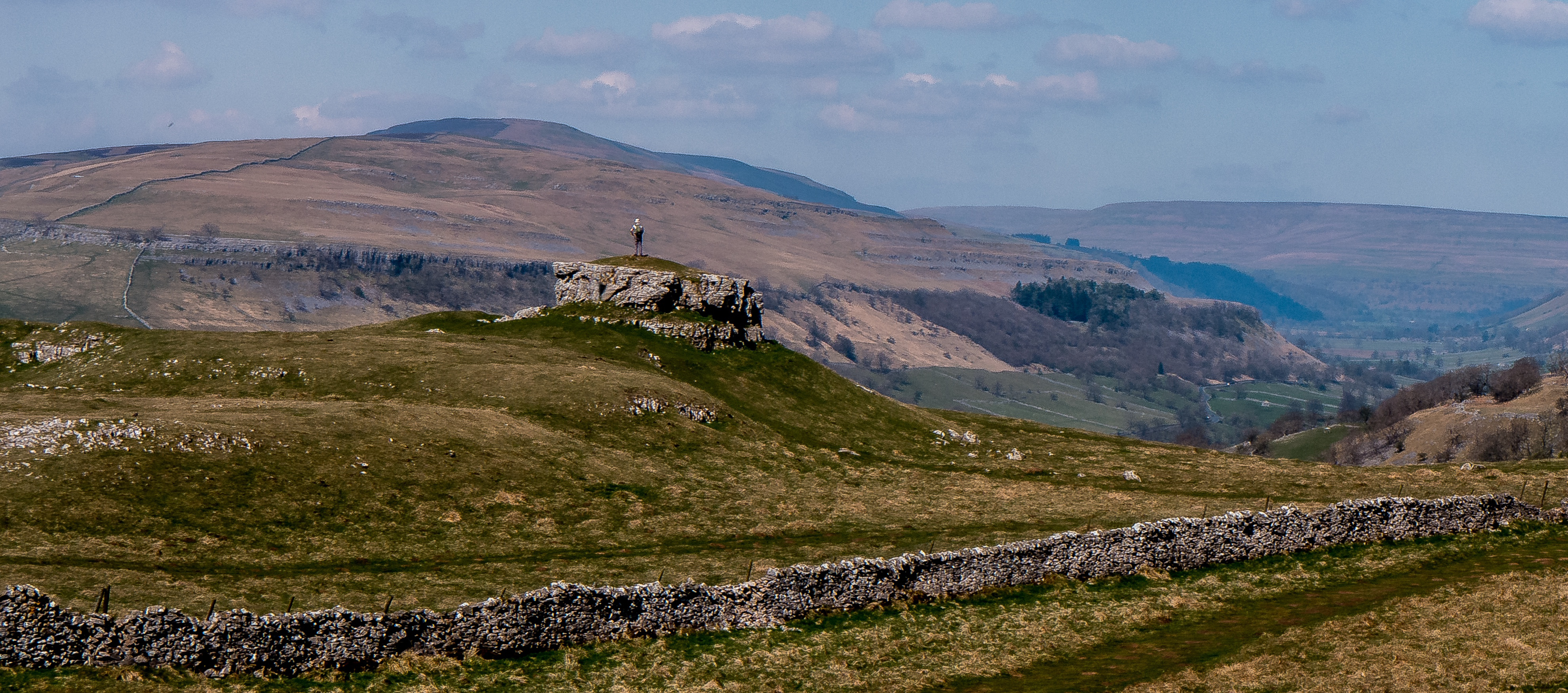
As we climbed out of Grassington towards Conistone Pie, the weather was kind to us and the views magnificent. Conistone Pie incidentally is not a variety of Yorkshire Dales steak and kidney pie, but is in fact a natural limestone hummock topped with a cairn.
Conistone Pie
We had now walked twenty-one miles and the blisters on my heels were rubbing like sandpaper on nails. The only way I could ease the pain was by cursing Gary under my breath, especially when he kept increasing the pace. At twenty-three miles we passed Scargill House, a Christian retreat and I was sorely tempted to seek refuge there. However, remembering that there was at least one pub in Kettlewell we hastened, or rather, hobbled on. The last mile was agony as the rubbing of flesh accompanied every step. At last we arrived at the youth hostel to see a stuffed model of a climber attached to ropes trying to scale the front wall of the hostel. Was this some kind of sick joke indicating that to gain entrance we would have to do the same? Fortunately not and, as it was 5.00pm, we were let in.
I spent most of the evening with my ‘hot feet’ propped high up in the air on pillows and blankets to ease the ‘foot pounding’, blisters and other aches and pains. This has now become known as ‘The Dales Way Technique’. So beneficial was the treatment that I managed to hobble in trainers without socks to one of the three pubs. Blisters need air and I needed the pub.
The three backpackers Gary had assaulted earlier had already drunk half a bottle of whisky and fortunately, contrary to our earlier thoughts, they were not former paras or SAS. One of them, a bus driver from Nottingham, was off sick from work with back trouble, although he failed to give a satisfactory explanation of how he could walk with a huge backpack. Another was a Canadian mountain biker and basketball player and the third one was a depressed teacher, no doubt glad to get away from his pupils. Returning to the youth hostel, we discovered our dormitory was rather small and the sound insulation to the next dormitory was poor. A group of youngsters were having lively discussions next door until 1.00am and sleeping was difficult; however, as youth hostels are essentially for youngsters I prefer not to complain. I was young once, although it is difficult to remember.
Post 10: After dragging Gary from his newspaper, we continued along the delightful River Wharfe reaching the ‘Strid’, where the river narrows through the gritstone rock. Legend has it that the Boy of Egremont was killed here in the 12th century trying to jump across the river. Having had one unsuccessful attempt at ending his walk, Gary immediately thought about another try but, when I pointed out the path continued along the river, for once he followed my directions.
Gary is a retired ‘twitcher’ (a keen bird watcher) and his suicidal tendencies evaporated when he saw a dipper. To be a twitcher you normally have to have endless patience, something Gary definitely doesn’t have; hence his early retirement from the activity. Like walkers, cyclists, anglers and runners, twitchers are the only people you see out and about at 7.30am on a Sunday morning. All other sane people are still tucked up in bed waiting for their paper to come through the door; they then amble downstairs to pick it up before returning to the warmth and comfort of their bed. Twitchers are so keen they will leave the house in fog, cold, rain, dark, frost and even snow to pursue their obsession of seeing a Siberian yellow-billed tit or such like.
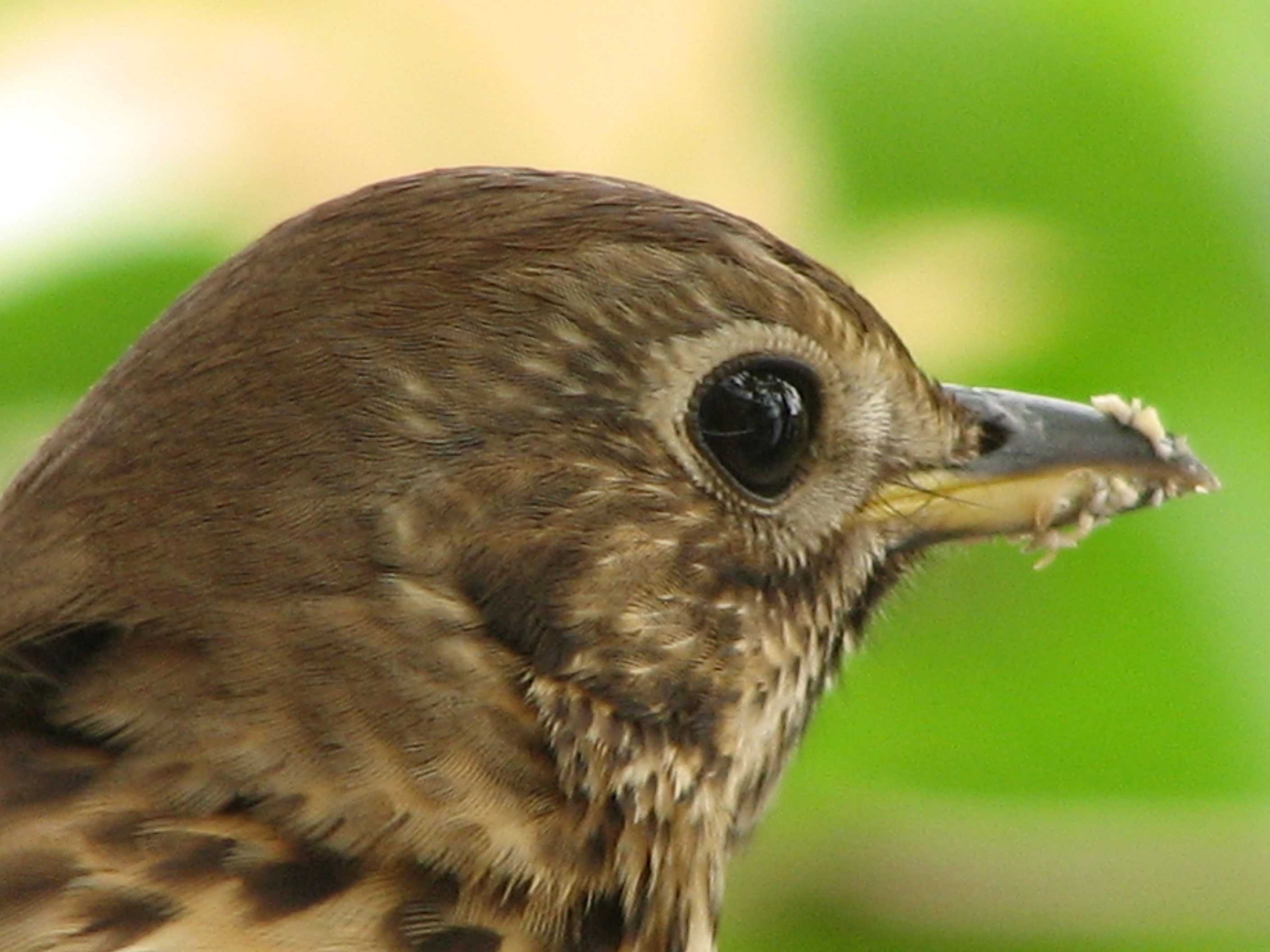
Blackbird
I haven’t the patience to sit for hours with binoculars waiting for a bird that, when it comes along, I can never recognise. However, on the Dales Way we did encounter a lot of birds including: wren, dunnock, tree sparrow, house sparrow, coal tit, blue tit, great tit, long-tailed tit, robin, chaffinch, greenfinch, bullfinch, stonechat, wheatear, skylark, meadow pipit, tree pipit, grey wagtail, yellow wagtail, pied wagtail, song thrush, mistle thrush, blackbird, starling, collared dove, wood pigeon, stock dove, great-spotted woodpecker, magpie, carrion crow (waiting for fallen Dales Way walkers?), partridge, pheasant, kestrel, peregrine falcon, buzzard, little owl, dunlin, lapwing, oyster catcher, curlew, grey heron, moorhen, mallard, swan, herring gull, and black-headed gull. To name but a few!
Blackbird
After about fourteen miles we adopted a fast pace, such that we became a risk to other walkers; had there been a speed limit we would have broken it. I can only think that Gary decided that, in order to opt out of the walk, he might be able to feign injury by ‘crashing’ into other walkers. He succeeded in wacking three walkers with his rucksack as he sped past. He bounced off them as they were carrying huge packs and appeared to be former paras or SAS; they gave Gary a mean look. We eventually came to a grinding halt for lunch at Linton Falls, some 16 miles into the walk. It was full of tourists and day-trippers, out for a quiet day in the country but herding together as though walking down Oxford Street in London. We left Linton Falls, glad to get away from the crowds, then, after a couple of hundred yards along the River Wharfe, re-captured the quiet and beauty of Wharfedale. It is a blessing that most visitors to the countryside will walk no more than a couple of hundred yards from their car and so leave hundreds of acres for the rest of us to wander about in peace and relative solitude.
Post 9. It was a bright sunny morning when we arrived for our photo call at the start, Ilkley. Looking like ‘Little and Large’ we were very cheerful, somewhat oblivious to what we were about to embark on. Ilkley has an air of prosperity, being within commuting distance of the huge city of Leeds. We were a little nervous as we left this comfortable town. Progress was easy as we followed the River Wharfe for some six miles, breaking into the song ‘On Ilkla Moor Baht’at’ which, translated into English, means ‘On Ilkley Moor without a hat.’ Ilkley Moor is the high moor stretching to the south of the town and I was relieved we were not climbing it, with or without a hat.
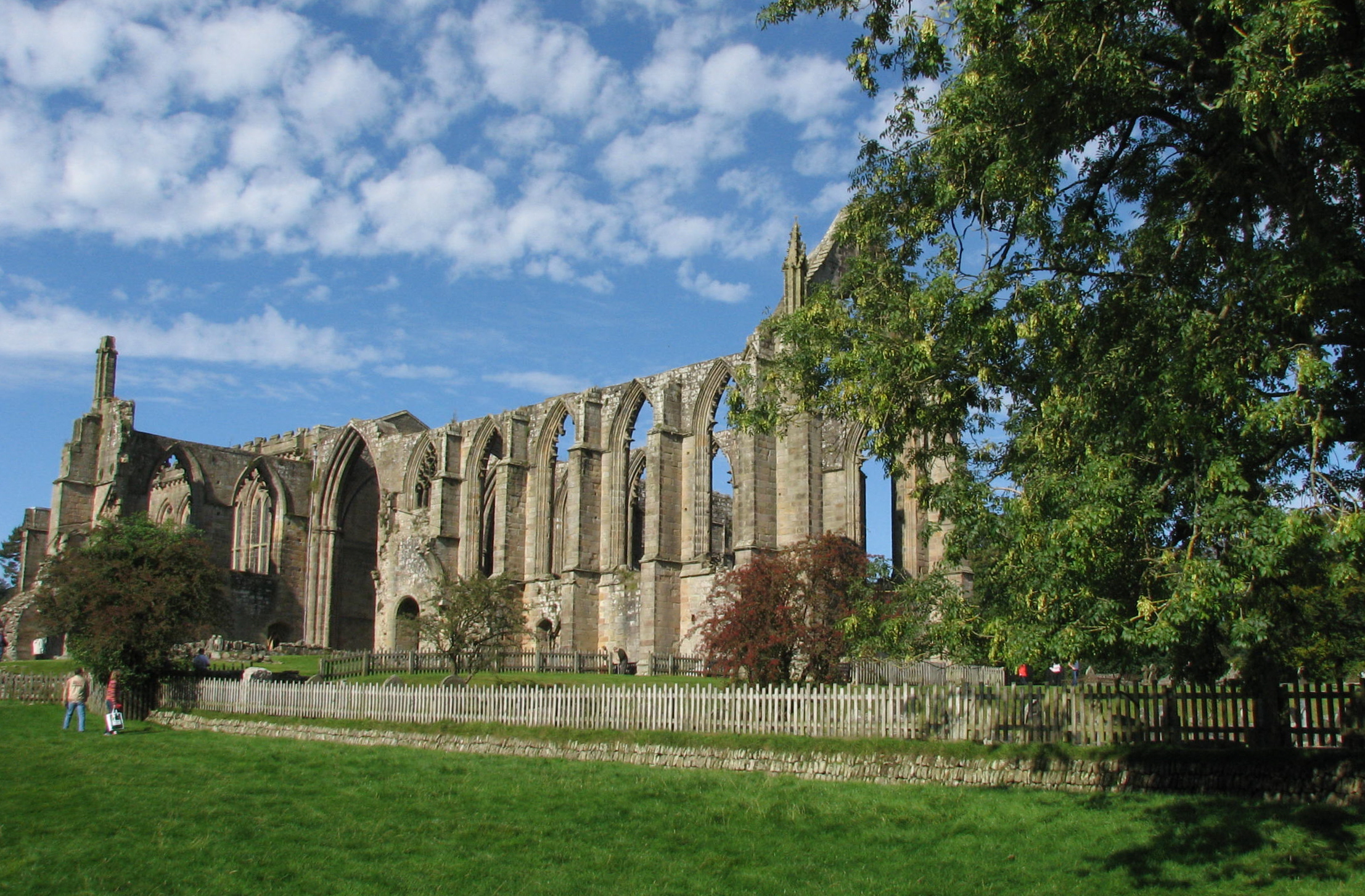
We eventually reached the fine ruins of Bolton Abbey, an excellent stop for snacks and for Gary a read of the Sunday Times.
Bolton Abbey – rocket launch site
It is one of a number of tourists honey-pots en route where, particularly at bank holidays, you have to be careful not to trip over sun-bathers clad in beach-wear, grannies with walking sticks and excited toddlers. Gary started to unscrew the top off his drinks bottle and suddenly:
‘WHOOSH.’
The top took off like a space shuttle being launched, then, after reaching mach 2, hit him on the nose. Suddenly, blood spurted from his nose.
‘ Have you got the first-aid kit?’ he said.
‘Don’t be daft, you were supposed to bring the first aid kit.’
Seeing that the injury was not fatal I burst out laughing. I then realised that he had been carrying a bottle of pop for six miles, which had been bobbing up and down in his rucksack, increasing in pressure all the time. Had we carried on for another couple of miles we could have been the first recorded long-distance walkers to die through a pop bottle explosion.
Bolton Priory had been in existence since 1154, but had never before had a ‘rocket launch’ in its grounds. Imagine the memorials that could have been erected to us. Gary cleaned up his nose with the Sunday Times, almost certainly inducing lead poisoning. I then managed to find a plaster from my emergency supplies to cover up the unpleasant sight of blood. Gary carried on reading as though nothing had happened. Clearly I was in for an interesting walk with my kamikaze walking companion.
Help! The penultimate day before embarking on my first long-distance walk I was nursing a one-inch blister on my heel. I had obtained the blister on a practice walk, with full pack, the previous weekend. It still hadn’t heeled up and I now had grave doubts as to how I could walk over 80 miles with a blister. I was getting desperate and, in order to dry the blister, resorted to using the hair-drier on it and sitting outside with it exposed to the sun (in April)!
I went to the village to buy last minute provisions and met Gary’s wife.
‘Is Gary ready for the off tomorrow?’ I asked confidently.
‘He hasn’t packed yet,’ she replied. ‘What time are you going?’
‘Hasn’t he told you yet?’I said surprised.
‘No, where do you start the walk?’
‘You are picking me up at 7.30am and dropping us off at Ilkley in the Yorkshire Dales.’ I imagined that Gary had scuppered all my well-laid plans.
‘Oh,’ she replied, clearly horrified at having to get up on a Sunday so early.
8 April 1990: Day 1 – Ilkley to Kettlewell Youth Hostel – 24 miles
Left York at 8.00am, half-an-hour later than planned, due to Gary insisting on buying the Sunday Times to take on the walk. I looked at him aghast as it is well known that paper boys hate having to deliver the Sunday Times beyond two yards and here was Gary planning to carry it for 24 miles, possibly longer if he didn’t read it all on the first day. At an average of two pounds and nine ounces, the Sunday Times is just too heavy to carry on a long-distance walk, but not for Gary. It usually takes me a week to read it as I never have the time to read it in one go.
‘Did you bring the first-aid kit?’ I asked as we approached Ilkley.
‘Oh damn,’ Gary said. ‘I forgot it.’
‘Never mind, I have some blister kits and perhaps we won’t need it,’ I said, trying to be optimistic.
Fortunately my rucksack was a bit more modern than this one.
Post 7: The full list of items of equipment taken on the Dales Way were:
Clothes
Waterproof jacket
Waterproof over-trousers
Gaiters
Boots with spare laces. They should allow the feet to increase by half a size on a two week walk, quarter of a size on a one week walk
Trainers, also with room for foot expansion
Walking Socks x four pairs. Preferably 1,000 mile blister free socks. When I did the walk they only seemed available through mail order, but they are now in most outdoor shops. Preferably start the walk wearing two pairs (one thicker and one thinner pair) and, as the feet expand and harden, reduce to one pair.
Evening socks x one pair
High-Tech windproof winter top or fleece
High-Tech windproof summer top
Shirt x two
Wickable T-shirt/vest x two
Underpants/boxer shorts x three
Walking outdoor trousers x two/three. One x Winter pair, two x lightweight summer. Do not wear breeches as your long-distance walk cred will reach zero
Body warmer
Gloves
Waterproof breathable hat. Don’t worry if people say it is too small; in an 80 mph gale it will stay on. To keep the rain off your face a ‘Stormin Norman’ style with peak is useful
Balaclava – if walking in highly exposed areas, Spring, Autumn or Winter
Accessories
Washing Kit
Razor – it is important to keep up appearances on a walk.
Small tube of shaving cream
Field towels x two
Concentrated liquid soap – much better than a soggy bar of soap
Small toothbrush and toothpaste – available from the Body Shop. Alternatively break the handle of an ordinary toothbrush in half.
Concentrated shampoo
Travel Wash for washing clothes
Camera – preferably one that fixes to your belt so as to be readily available. Spare battery and charger. Memory Cards.
Films (slides) x 2 for one week, x 4 for two weeks. (*authors update – I went digital in July 2006 and I am sure you will have done so by now!).
Pen/pencil for writing your diary or postcards.
Notebook
Tissues/Handkerchief
Flask x 2 (one for tea and one for soup)
Water bottle x 1 (Platypus in order to drink whilst on the move)
Card with telephone number of next of kin – just in case!
Torch
Compass
Maps and waterproof map holder
Survival bag
Tea bags
Sugar in plastic container
Coffee mate in plastic container
Food bags for food and anything you want to keep dry
Rucksack liner to keep clothes dry
Boot waterproofing, a J-cloth and scraper for cleaning boots
Foam seat. This is the ultimate luxury, very light to carry but guaranteed to keep your buttocks warm and dry when you stop for the highlight of the day, your lunch
Sewing kit – just a small emergency one
Change for coin box telephone (pre-mobile phones) / now replaced by a mobile phone and charger.
Emergency Rations
Chocolate/ Mars bar
Muesli bars/Tracker bars
Dried apricots/nuts
Toilet paper
With the above equipment it should be possible to walk for up to 200 miles between the middle of March and the middle of November, keeping the weight down to an acceptable 30lbs and at the same time enjoying the walk in comfort. With modern clothing you can keep warm and dry without carrying too much weight. My philosophy on walking is to be as comfortable as possible so that the scenery can be fully enjoyed. In recent years outdoor clothing has led many fashions and now, when going around town, it is impossible to tell the outdoor types from the fashion followers. However, you do not need an expensive waterproof jacket to walk round town; save it for when you are on the hills when its qualities will be fully utilised. My teenage children would never accept that much modern fashionable clothing developed from high-tech outdoors clothing. Even ‘bobble’ hats, first worn by walkers, briefly came into fashion amongst their age group! Apart from a waterproof jacket and over-trousers, a hat is the most important clothing as some thirty per cent of heat is lost through the head. Although hats are not a very fashionable item in the High Street, they are essential on the fells. It is a little unfortunate that many outdoor hats are designed with a big air space in the top, which makes you look as though you are walking around with the Empire State building perched on your head.
Even the punk star, Sid Vicious, couldn’t compete with serious walkers in the number of zips he wore. On one occasion, to pass time in the pub, I counted thirty-three zips on my clothing. Most specialist walking clothing has zips in order not to lose all the essentials. Therefore, you can end up like a mobile zip factory. However, I have yet to meet a walker who has a safety pin or ring through his nose, lips or ear; they are better used for a temporary repair job on your trousers or for bandaging a wound.
As I would supply and carry the maps and guide-book for the walk, Gary was asked to supply the First Aid kit, to include blister kits, Radian B, and Witch Doctor. The last three items cover most of the common ailments encountered on a long-distance walk, in fact Witch Doctor seems to sooth and treat nearly everything, chaffing, skin irritation, itching, insect bites, sunburn, minor burns, bruises, grazes, blemishes, infection, swelling, spots, although not a hang-over.
About a month before the walk, I decided to draw up a list of items that would be needed for the walk, then, having collected it all together, tried to get it into the rucksack. Have you ever tried to get your wardrobe into a rucksack?
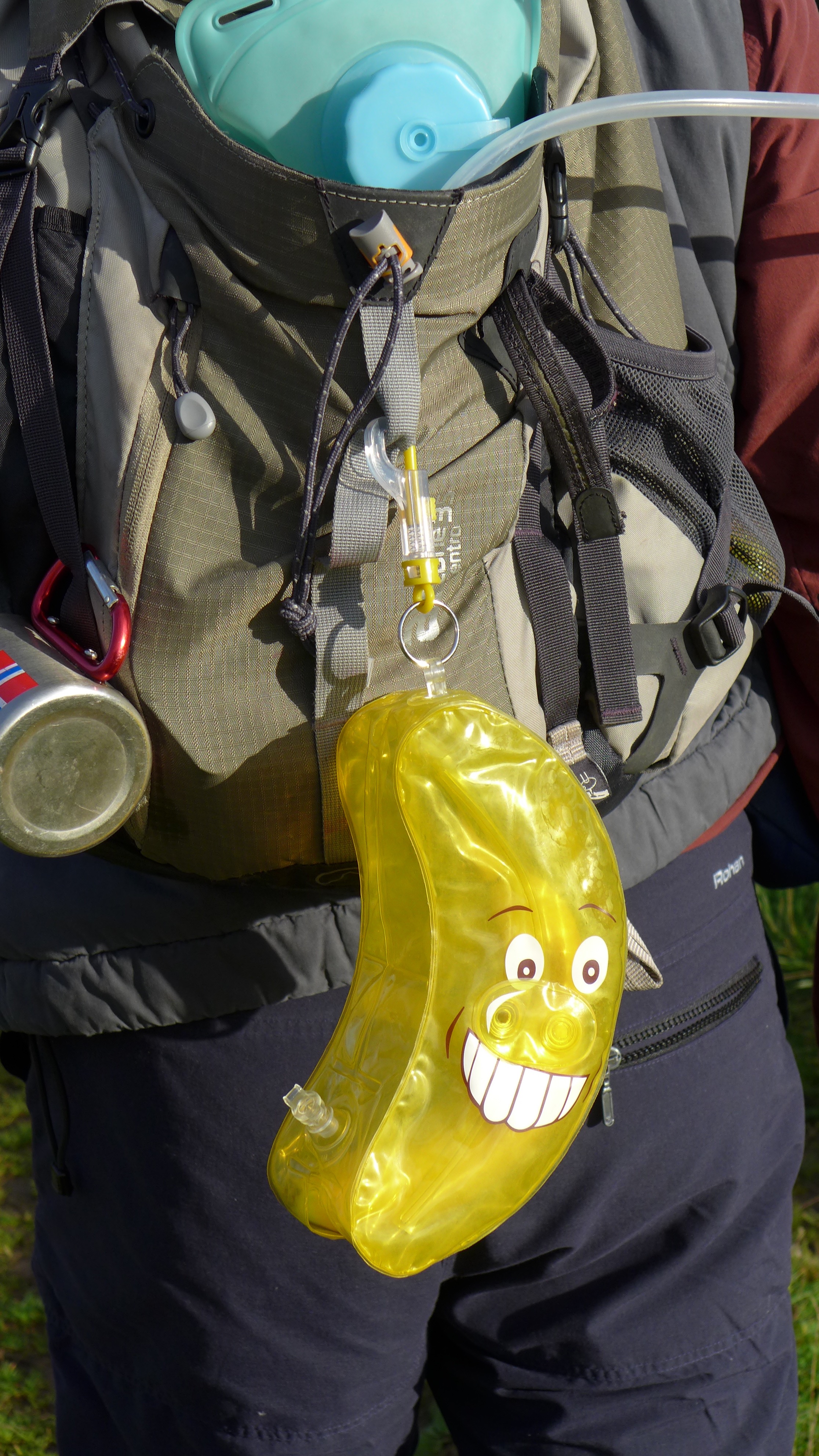
One rucksack with essential banana protector (present from a ‘thoughtful’ friend!). The blue plastic thing with the tube is a platypus drinks container essential to allow drinking on the move.
It proved impossible but, after throwing out a lot of clothes and wondering whether I would be walking half-naked, I eventually succeeded. I tried to lift the rucksack to find that I could hardly get it off the ground. Have you ever tried to lift a bag of potatoes? It felt the same. Panic set in and I quickly threw out a further two pairs of underpants. This still left three which, with a bit of ‘crop rotation’ washing en route should suffice; each day wear one pair, dry another and wash another. Four pairs of ordinary socks were then removed leaving one pair for the evenings; this should be sufficient as most of the time I would be wearing walking socks. The toothpaste and shaving foam seemed heavy and so next day I went to the Body Shop to buy some much smaller travel toothpaste, a tiny toothbrush and a small tube of shaving cream. A visit to the local outdoor shop led to the purchase of concentrated soap and field towels. The latter are like silk, dry very quick and, unlike ordinary towels, are not bulky. The disadvantage is that they go cold when wet and, after a shower, it’s like putting ice on your back.
The full pack – 28lbs max
My wife had treated me to a very expensive, lightweight, windproof replacement for my heavy pullovers. I have never understood the logic of women. On occasions they can make you feel guilty for going away for a day’s walking but in the next breath they treat you to some expensive equipment which, presumably, is to encourage me to go away. I have given up trying to understand the inconsistencies, but just accept them in the same way as I accept varying weather. Maybe, instead of weather forecasts, we should have women forecasts? Still, for some reason, she was generally supportive of my forthcoming escape from domesticity.
If you want to be a serious walker, either remain single or, if you do get married, make sure your wife is not obsessive about ‘do it yourself’ jobs around the house; otherwise you will be chained to decorating the house every weekend and holiday. She must also like her own company from time to time so that she is pleased to see you disappear for a few days.






 secretwalkscom